
REVIEW · GOTHIC QUARTER TOURS
Walking tour of the Gothic Quarter of Barcelona + Cathedral
Barcelona’s Gothic Quarter makes instant sense here. This private Gothic Quarter walk, led in English, strings together major landmarks like Barcelona Cathedral and lesser-seen corners so the area feels legible fast, not random.
I really like the way the guide turns famous facades into something you can picture historically, especially with the stop mix from the Neo-Gothic Basílica dels Sants Màrtirs Just i Pastor to the older layers you run into around Temple d’August. I also like the practical rhythm of the tour, about 20 minutes at each place, which keeps the pace steady for a morning or afternoon.
One thing to weigh: most stops are described as not accessed inside, and admission tickets are not included for many sights. If your dream day is mostly indoor time, you may want to plan extra ticketed visits on your own.
Key highlights you’ll care about
- A focused, private route that keeps the group small and only your group participates
- Eight stops in about three hours, with short stops that are easy to follow
- Period mix across Roman to Neo-Gothic and medieval government buildings, so the city layers click
- Clear end point at Plaça del Pi area, finishing at Basilica de Santa Maria del Pi
- Exterior-first sightseeing, with a few free square stops like Plaça del Rei and Plaça de Sant Felip Neri
- Good advance support, including a guide who explains the meeting point well and can send a contact phone number ahead of time
What you’ll actually get from this Gothic Quarter plus Cathedral walk
This is the kind of tour that helps you stop wandering and start understanding. In three hours, you cover a tight loop through the Barri Gòtic area landmarks you’ve heard of, plus a few spots that feel less obvious when you’re doing it on your own.
The pacing matters. Instead of one long church visit, you get a sequence of short, story-driven stops. That’s great for first-time visitors because it gives you context while the streets are still fresh in your mind.
Also, the format is simple: you’re walking, you’re looking, and you’re getting the “what this is and why it matters” from a guide. The tour is listed as English, and it uses a mobile ticket, so you can keep everything on your phone.
You can also read our reviews of more walking tours in Barcelona



Price and value: is $180.24 per person fair?
At $180.24 per person for about 3 hours, this is not a bargain-basement walking tour. But the value isn’t just distance or number of stops. It’s the combination of a private setup, a guided narrative that links the sites, and a route that saves you time figuring out what to look at.
Here’s the math you should do in your head. Many stops have admission tickets not included. So your real total can be higher if you decide you want to go inside places on your own before or after. On the flip side, two key square stops are listed as free: Plaça del Rei and Plaça de Sant Felip Neri.
So who wins with this pricing?
- You want a guided orientation to the Gothic Quarter and don’t want to spend your limited time just trying to decode buildings.
- You prefer “see it, then understand it” over “wander and hope you figure it out.”
If you mainly want interior visits and long ticketed time in major monuments, you may end up paying for this plus extra entry costs elsewhere. That doesn’t make the tour bad, it just means it fits a certain travel style.
Meeting point at Plaça de l’Àngel, how the start and finish work
The tour starts at Plaça de l’Àngel, Ciutat Vella, Barcelona, Spain and finishes at Basilica de Santa Maria del Pi, Plaça del Pi, 7, Ciutat Vella, 08002 Barcelona.
Why this matters: you’re meeting in the old city core and ending near a major church, so the walk is naturally “start in the thick of it, finish with a strong landmark.” For me, that’s easier to plan than a tour that ends somewhere random and requires a last-minute transit scramble.
A practical bonus from prior experience with this operator: the guide tends to explain the meeting point clearly. In one case, the guide even sent a phone number by email ahead of time, which is helpful if you arrive a few minutes late or you’re sorting out which corner you’re on.
Stop-by-stop: from Basílica dels Sants Màrtirs to Santa Maria del Pi
This route is built like a chain of clues. You move from one architectural world to the next, so by the time you reach Barcelona Cathedral, you’re not just looking at a landmark, you’re seeing Barcelona’s layer-cake.
Also note the common pattern: most stops are described as not accessed inside the enclosure. That means your best experience will come from looking closely and letting the guide narrate what you see.
Stop 1: Basílica dels Sants Màrtirs Just i Pastor (Neo-Gothic, outside viewing)
You begin at Basílica dels Sants Màrtirs Just i Pastor, described as a famous Neo-Gothic Catholic church of 1342. Even though the stop is not for interior access, the exterior can still tell a story. You’ll get a quick orientation to how Neo-Gothic works as a style and where it fits in Barcelona’s longer timeline.
If you like architecture, this is a good opener. It sets expectations for the look of the area, so later Gothic and medieval structures don’t feel like they all blur together.
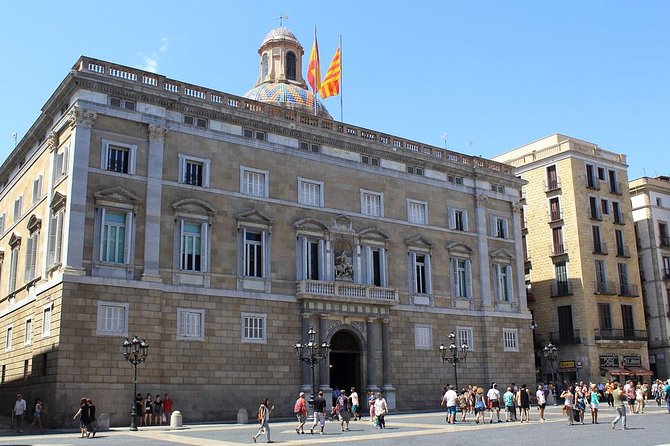
Stop 2: Palau De La Generalitat De Catalunya (medieval government life)
Next is Palau De La Generalitat De Catalunya, seat of the Presidency of the Generalitat of Catalonia. The description emphasizes something important: it’s one of the few buildings of medieval origin that stays in the role of government and institution that built it.
That’s more than trivia. When you stand near a building that still functions in the same broad purpose, you get a different perspective on the city. It’s not only about the past, it’s about continuity, even when styles and politics have shifted over centuries.
Again, this stop is described as not accessed inside the enclosure, so focus on the building’s presence and the square-like feel around government buildings.
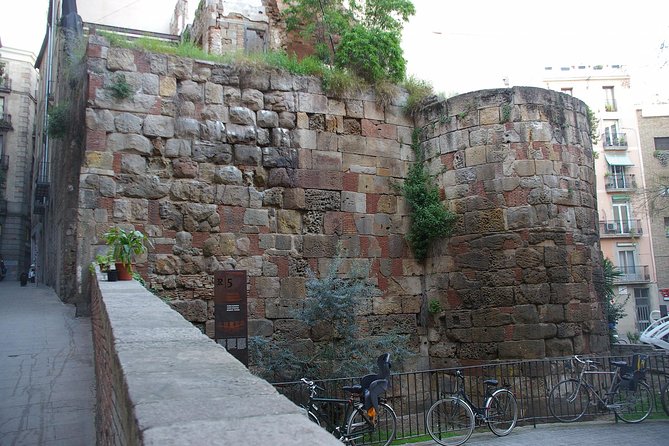
Stop 3: Temple d’August (Roman roots you can spot once you know what to look for)
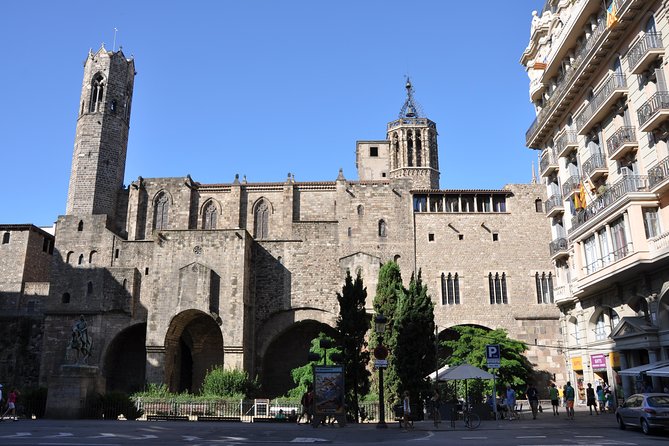
Then you hit Temple d’August, the Temple of Augustus. It’s described as a Roman temple dedicated to the imperial cult of César Augusto, built in Barcino, a colony founded with permission of Augustus.
This stop is a shortcut to a big realization: Barcelona is not only Gothic. The city’s Roman layer is right there, if you know what you’re looking at.
Because the stop is not for interior access, your guide’s explanation becomes even more important. You’re basically learning to read the structure from the street.
Stop 4: Plaça del Rei (a monumental square, free)
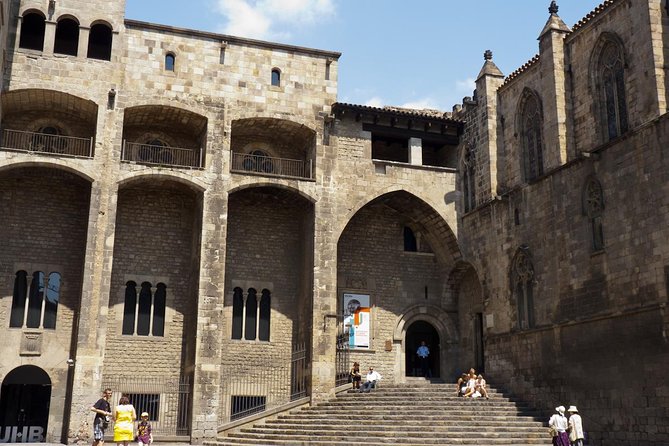
Plaça del Rei is where you slow down a touch and absorb the setting. It’s described as a monumental square surrounded by Gothic and Renaissance buildings, and the admission is listed as free.
Squares like this are underrated when you rush through. They act like open-air classrooms, you can take in proportions and sightlines, and the architecture has room to make its point. If you’re trying to photograph Barcelona with meaning, this is a strong place to do it.
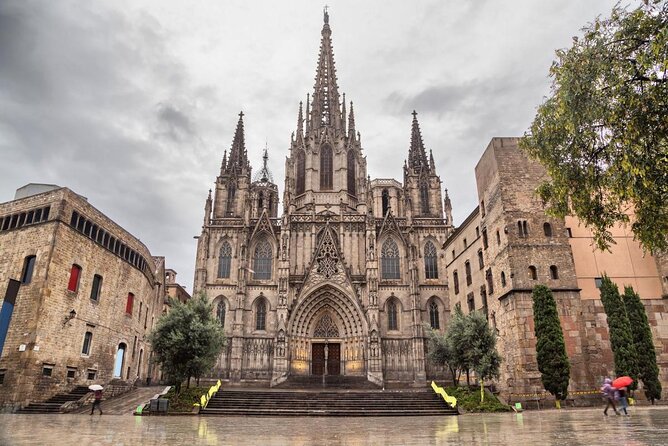
Stop 5: Barcelona Cathedral (outside look, big learning payoff)
You’ll get history focused on the Cathedral of Barcelona at Stop 5, and the listing notes it is not accessed inside the enclosure.
This is a key consideration. You should expect an outside viewing experience and guided context rather than a long interior visit. If you want the cathedral as a museum experience, you might need to add an extra visit separately.
But if you’re doing this tour as an orientation, the cathedral stop can be a turning point. Once you understand how the guide frames the cathedral’s role and development, your later independent visit will feel more grounded.
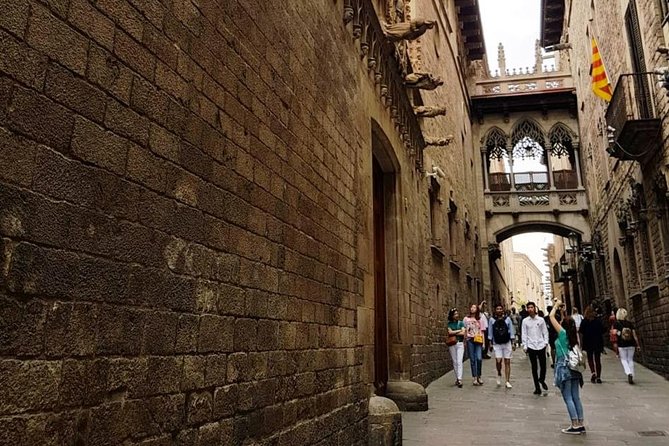
Stop 6: Casa de l’Ardiaca (one of the secret spots)
Next is Casa de l’Ardiaca, described as one of the secret tourist spots that very few people know. It also notes no interior access.
So what do you do with a “secret” building when you can’t go inside? You look for what’s unusual from the outside, and you listen for the guide’s explanation of why it matters. These are exactly the places where independent reading helps, but a guide can shorten the learning curve and point out details you might otherwise miss.
Stop 7: Plaça de Sant Felip Neri (free, famous for essence and history)
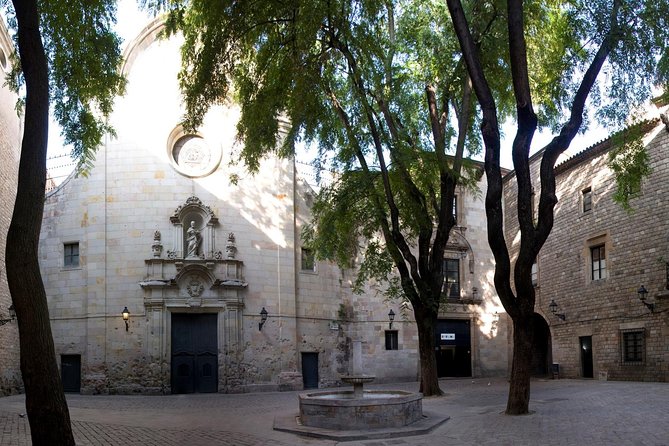
Then you’re at Plaça de Sant Felip Neri, described as famous for its essence and the history it hides, with admission listed as free.
This is another square stop, which is smart in a walking tour like this. Squares give you breathing room, and they’re a good place to stop and let the stories connect. By this point, you’ve seen enough layers that you can start to predict how the guide will link the next landmark.
Stop 8: Basilica de Santa Maria del Pi (end point, with mention of entering)
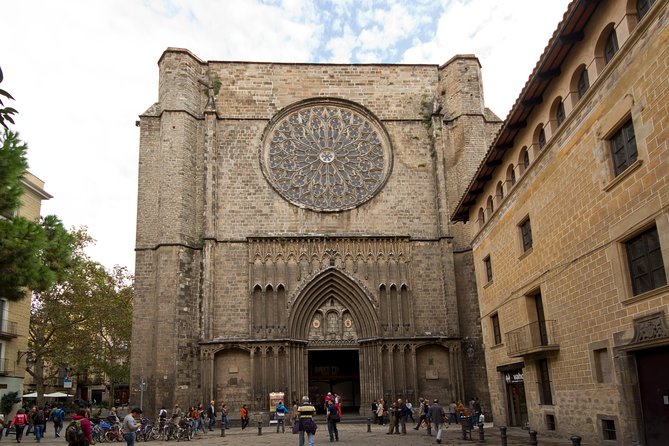
The tour finishes at Basilica de Santa Maria del Pi. The ending point is clearly listed at Plaça del Pi, 7, and the description says you’ll discover and enter together one of the most important and famous basilicas in the city.
So plan on some time at the basilica itself as the wrap-up. For me, ending with a final strong place of worship and architecture is an easy way to keep the tour from feeling like it just fades out after a cathedral stop.
How to get the most out of an exterior-focused tour
Because many stops are described as not accessed inside the enclosure, your results depend on your attention. This is not a passive tour. You’ll do better if you treat it like a walking lecture where the buildings are the textbook.
A few practical ways to make that work:
- Keep your phone away except for photos, so you’re not constantly switching contexts.
- Look up at details when the guide mentions the building period, then compare it to the last stop.
- If you’re the type who loves reading plaques, use the guided stops to decide which monument you want to follow up with later.
And if you care about interior access, don’t assume the cathedral is included as a full inside experience, since the listing says not accessed inside the enclosure. The basilica stop is described as including entering, so at least one place on the route may offer more than exterior viewing.
Who this walking tour suits best
This tour is a strong fit if you:
- Want an early introduction to Barcelona’s Gothic Quarter and Cathedral area, so the rest of your trip makes more sense.
- Prefer a short, guided route rather than a half-day of tickets and long museum-style visits.
- Like architecture and want the “why this building exists” angle, not just dates.
It may not be the best fit if you:
- Want mostly indoor access at major monuments.
- Are hoping for a long, cathedral-centered visit that includes significant time inside.
Should you book this Gothic Quarter + Cathedral walk with Willy’s Plan?
I’d book it if your goal is to understand the Gothic Quarter quickly and see the main players without losing half your day to figuring things out. The private feel, English guidance, and tight three-hour schedule make it a smart use of time, especially early in your Barcelona trip.
I’d think twice if your priority is interior access across the board. The listing describes several stops as not accessed inside the enclosure, and admission tickets are generally not included for many sights. In that case, pair this tour with a separate plan for the cathedral and other interiors you want to truly experience up close.
Bottom line: if you want your first encounters with Barcelona’s medieval and Roman layers to feel guided and logical, this is a strong choice. It’s not about cramming every entry ticket into three hours, it’s about getting the story straight so you can explore with confidence afterward.
FAQ
How long is the walking tour?
It lasts about 3 hours.
How much does the tour cost?
The price is $180.24 per person.
Is the tour offered in English?
Yes, it is offered in English.
Where does the tour start and end?
It starts at Plaça de l’Àngel in Barcelona and ends at Basilica de Santa Maria del Pi, Plaça del Pi, 7, Barcelona.
Is this a private tour?
Yes. It is described as a private tour or activity, with only your group participating.
Do we enter the Cathedral during the tour?
The Cathedral stop is described as not accessed inside the enclosure, so plan for an outside visit with guided history.
What about admission tickets for the sights?
Admission tickets are listed as not included for most stops. Plaça del Rei and Plaça de Sant Felip Neri are listed as free.
What happens if weather is bad?
This experience requires good weather. If it’s canceled due to poor weather, you’ll be offered a different date or a full refund.
Can I cancel for a full refund?
Yes. You can cancel up to 24 hours in advance for a full refund.
More Walking Tours in Barcelona


More Tours in Barcelona


More Tour Reviews in Barcelona
Not for you? Here's more nearby things to do in Barcelona we have reviewed








More Gothic Quarter Tours worth opening.
 ★ 5.0Barcelona Gothic Quarter Tapas & Taverns Food & Wine TourFrom $1311,470 reviews
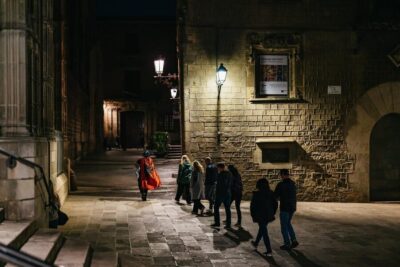 ★ 4.7Gothic Quarter Ghosts and Legends Walking TourFrom $191,443 reviews
 ★ 4.8Old Town and Gothic Quarter Walking TourFrom $211,393 reviews
 ★ 5.0Barcelona Old Town & Gothic Quarter Small Group TourFrom $221,308 reviews
 ★ 4.8El Born and Gothic Quarter Wine & Tapas Bar TourFrom $81674 reviews
 ★ 5.0Kids and Family Gothic Quarter Walking Tour in BarcelonaFrom $25465 reviews
 ★ 4.5Barcelona Gothic Quarter Walking TourFrom $33456 reviews
★ 4.9Gothic Quarter Walking TourFrom $212383 reviews
★ 4.5Barcelona Gothic Quarter Walking TourFrom $33456 reviews
★ 4.9Gothic Quarter Walking TourFrom $212383 reviews
Continue by place or experience