
REVIEW · GOTHIC QUARTER TOURS
Private Barcelona Old Town Walking Tour: Gothic Quarter & Born
Barcelona wears its history on every corner. This private 3-hour walk through the Gothic Quarter and Born keeps the story moving, and I love how the route gives you a tight sense of place fast. It also helps that the guide, Alfredo, explains what you’re seeing using historical documents and pictures, so the streets stop being a blur and start making sense.
The main catch is cost details. Two major stops list admission as not included, and if you want to go inside those places you’ll likely pay extra. Also, it’s a walking tour with lots of short photo stops, so if you prefer long museum time, you may want a second visit later.
Key Points to Know Before You Go
- Alfredo’s street-level storytelling uses historical documents and pictures while you walk
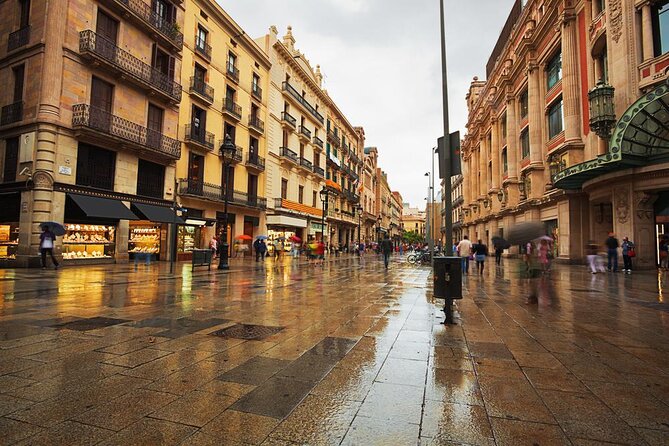
- A smart Gothic to Born route in about 3 hours, starting at Passeig de Gràcia and ending at Mercat del Born
- Most stops are free to enter, with only a couple marked as not included
- You’ll connect Roman, medieval, and Catalan civic Barcelona in one continuous walk
- Iconic photo spots show up at the right moments, like Pont del Bisbe and Plaça Reial
- The tour ends with a food choice near Patisserie Hofmann, so you can stay for dessert or a drink
Why This Gothic Quarter and Born Walk Works in 3 Hours
This tour is built for people who want an overview, not a slow crawl. You cover a lot of ground in about 3 hours, but the pacing stays sane because you’re always walking toward the next idea. One moment you’re at the city’s modern-to-old gateway, and the next you’re staring at Roman-era traces, then medieval power, then Born’s preserved layers.
What I like most is how it balances big landmarks with the small stuff that makes the old streets feel real. You get architectural stops like the Cathedral area, civic buildings like the city hall and Generalitat, and then culture details like the castellers tradition memorial. It adds up to a walk that feels like Barcelona has a clear “plot,” not just a stack of sights.
And since it’s private, you’re not sharing the guide’s attention with a huge crowd. That matters with a tour like this because Alfredo’s style is interactive, using prepared comparisons to explain how the city changed.
You can also read our reviews of more walking tours in Barcelona



Starting at Apple on Passeig de Gràcia, Then Sliding Into Las Ramblas
You meet at Apple on Passeig de Gràcia at 4:00 pm, then head into the oldest streets. It’s a good starting choice because it anchors you in a famous transit-friendly area, and you can easily get there with public transportation.
Plaza de Catalunya: The briefing square
Your first stop is Plaza de Catalunya. The guide gives a briefing right there in the center, for about 15 minutes. That opening matters because it helps you understand how the walk fits together, including what you’re about to see in the Gothic Quarter and Born.
Las Ramblas: The connector street
Next comes Las Ramblas, where the tour spends about 15 minutes. This is described as a vital street that connects the newer parts of the city with the port area. On a map it looks straight, but on the ground it’s a quick lesson in how Barcelona grew and where people funnel through.
Font de Canaletes: Barça celebrations and local ritual
At Font de Canaletes, you get a quick stop around 5 minutes. It’s tied to the Barça football club celebrations, which is the kind of local detail that makes a fountain feel less like a random object and more like a piece of everyday culture.
You can also read our reviews of more private tours in Barcelona

Mercat de la Boqueria: Market energy without the guesswork
Then you land at Mercat de la Boqueria, roughly 10 minutes. It’s framed as a key market on Las Ramblas. Even if you do not buy anything, you’ll get a sense of how food, tourism, and local life collide in this corridor.
Practical note: even when a stop says admission is free, you might still want to budget for anything you choose to eat inside the market.
Petritxol, Santa Maria del Pi, and the Call de Barcelona for Cultural Context
This part of the walk shifts from broad city movement into the older neighborhood texture. It’s where the streets start feeling smaller and more personal.
Carrer de Petritxol: The chocolate street
Carrer de Petritxol is the famous Street of Chocolate, with a short stop of about 5 minutes. You don’t come here for a long visit. You come to notice the street’s vibe and learn how the old quarters gained their modern identity without losing their historic bones.
Basílica de Santa Maria del Pi: A famous facade, with potential extra entry cost
Basílica de Santa Maria del Pi is next, also about 5 minutes. Admission for this stop is marked not included, so if you want to go inside, plan on paying separately. Even if you stay outside, this is still a good architectural anchor for the Gothic-adjacent lanes you’re moving through.
Call de Barcelona: The Jewish area
Then you reach Call de Barcelona, described as the Jewish area within the Gothic zone. The stop is short, around 5 minutes, but the point is clarity: this is not just one religious site after another, it’s a layered city with different communities living side by side over time.
Plaça de Sant Felip Neri: Beauty with the shadow of 1938
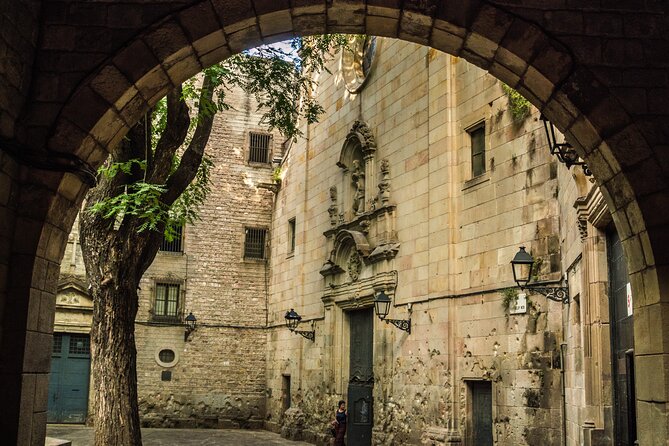
At Plaça de Sant Felip Neri, the tour lingers for about 5 minutes. It’s described as beautiful and sadly famous because you can still see traces of bombing from 1938. This is one of those moments where a quick stop becomes more meaningful, because the square carries history you can visually recognize.
Roman Barcelona in the Open: Walls, Columns, and MUHBA Ruins
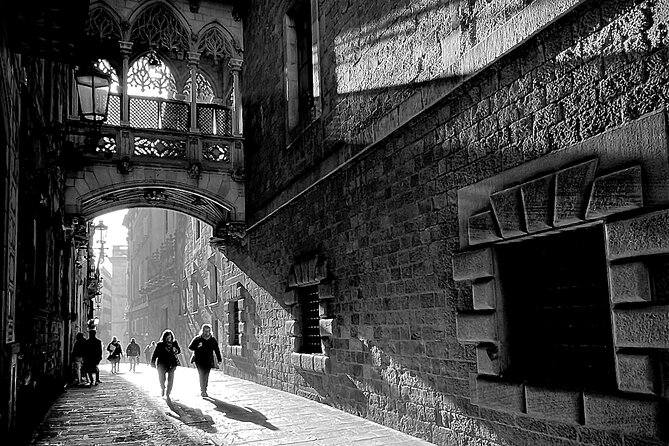
From here the walk starts stacking Roman elements with medieval and later Catalan power. The tour’s value is how it connects these eras without making you read a textbook.
Roman city wall entrance
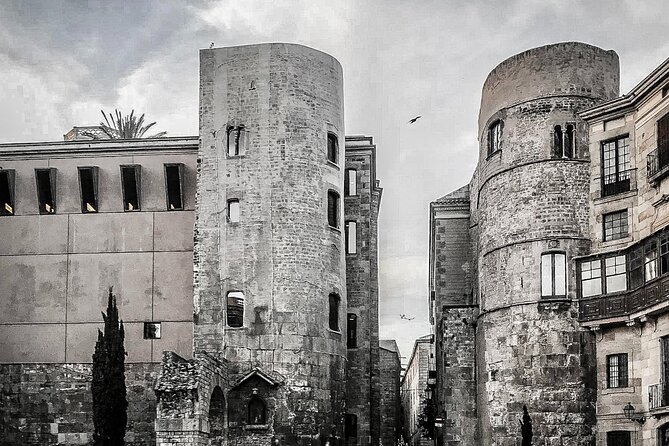
You’ll enjoy a Roman city wall and its Roman entrance for about 5 minutes. It’s one of the clearest ways to feel how Barcelona had defenses and a structured city plan long before the Gothic buildings we picture today.
Plaça d’Isidre Nonell: The Kiss mosaic
Next is Plaça d’Isidre Nonell, about 5 minutes, focused on a mosaic of The Kiss. This stop is small but useful, because it reminds you that modern art can live in the same spaces as ancient streets. It’s a reminder that cities keep changing, even in the oldest areas.
Cathedral of Barcelona: The anchor point
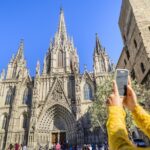
You then reach the Cathedral area for roughly 5 minutes. This is one of Barcelona’s visual anchors, and the quick stop works well here because by now you’re ready to understand what you’re seeing: stone power, religious centrality, and civic identity overlapping in one area.
Plaça del Rei: Royal Palace square and governance
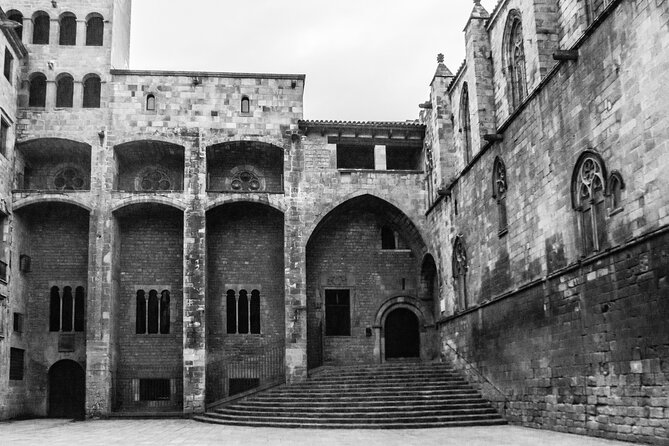
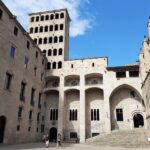
Plaça del Rei comes next, also around 5 minutes. The tour describes it as a monumental square surrounded by Gothic and Renaissance buildings, and notes that many are part of the Royal Palace, with roles as residence and seat of government for the Counts of Barcelona and the Kings of Aragon. Even if you only get a quick look, that explanation gives the square a bigger job than it seems like it has from street level.
Museu d’Historia de Barcelona (MUHBA): Roman ruins, big footprint
The walk then includes a quick stop at MUHBA, roughly 2 minutes. It’s described as a museum of Barcelona with 4000m2 of Roman ruins you can visit, but admission is not included. Two minutes sounds short, and it is, so think of this as a nudge to come back if you want more time in the museum.
Centre Excursionista de Catalunya: Temple of Augustus columns
Finally in this Roman run, you get to Centre Excursionista de Catalunya for about 5 minutes, centered on four columns from the Roman period (Temple of Augustus). This is the kind of stop where a small structure can explain a lot, especially if your guide points out why those columns matter in the broader story of the city.
Pont del Bisbe and the Power Centers: From Legends to Generalitat
Now the tour leans into civic Barcelona. You’re moving from religious and residential power into government space and local traditions.
Pont del Bisbe: Photo spot plus stories
Pont del Bisbe is next, about 5 minutes. It’s described as one of the most photographed bridges in Barcelona, and the guide shares its secrets and legends. Even if you do not snap a photo every time, this kind of storytelling makes the bridge feel less like scenery and more like a location people attached meaning to.
City Hall (Casa de la Ciutat / Ayuntamiento)
Then it’s City Hall, also about 2 minutes. This is a quick hit, but it places you in the administrative heart of the city rather than only the old-time postcard version.
Palau de la Generalitat de Catalunya
Palau De La Generalitat De Catalunya is next for roughly 2 minutes. The tour frames it as government space. Seeing it after the earlier square and cathedral stop helps you understand how authority moved and how Barcelona’s identity is tied to institutions.
Monument als Castellers: Human towers as living tradition
Monument als Castellers takes about 5 minutes. The tour explains castellers, the human towers tradition, and you’ll see a monument homage to that tradition. It’s a solid reminder that culture is not stuck in the past, it’s still performed today.
Plaça Reial, Orwell Square, and the Road to Santa Maria del Mar
This section is a mix of design, names, and street-level atmosphere. You’re also starting to transition toward Born.
Plaça Reial: A link between areas, with Gaudí street lamps
Plaça Reial is next, about 10 minutes. It’s described as a beautiful square connecting the Gothic area and Las Ramblas. You’ll also see Gaudí street lamps, noted as one of his very first works. The key value here is perspective: you’re watching the tour connect zones, not just visit sights.
Plaça de George Orwell: A named square in the mix
Then comes Plaça de George Orwell for about 5 minutes. The stop is short, but it adds a modern layer to an old walk, which helps the area feel like part of today’s Barcelona, not an open-air museum.
Plaça dels Traginers: An old Roman tower
At Plaça dels Traginers, you spend around 10 minutes to enjoy a very old Roman tower. This is one of those “blink and you miss it” moments, so having a guide who knows where to focus saves you time and turns a confusing location into something you can actually read.
Basílica de Santa Maria del Mar: Inside depends on timing
Then you reach Basílica de Santa Maria del Mar, about 15 minutes. It’s described as one of Barcelona’s most important basilicas, and the guide notes that depending on the time, you may be able to go inside the church. That conditional timing is actually helpful to you because it sets expectations: some days you’ll get more interior access than others.
Born’s Market Ruins and a Sweet Finish at Hofmann
Born is where the walk softens into atmosphere. You’re moving along a boulevard, then into a market space, then ending at a pastry stop that makes the whole afternoon feel like a proper plan.
Passeig del Born: The boulevard stretch
Passeig del Born is next, about 5 minutes. It’s described as a nice boulevard in the Born area. Think of it as the transition strip that helps you shift from historic density to a more relaxed neighborhood feel.
Mercat del Born: Roman roots and 18th-century ruins underground
Mercat del Born comes next for about 10 minutes. It’s described as a very old market, now a cultural center because you can see ruins of the 18th century underground. This is one of the tour’s best “how Barcelona layers time” examples. You can literally understand how the city changed by looking at what remains below.
Patisserie Hofmann: End here, taste your reward
The tour finishes at Patisserie Hofmann for about 15 minutes. You’ll see it as a top pastry shop in the city, and the guide leaves you with a choice, either dessert there or a drink at a nearby place. It’s a satisfying way to close, because you end with something tangible after hours of architecture and street history.
Price and Value for a Private, English-Language Walk
The price is $180.04 per person for an approximately 3-hour private tour offered in English. On paper, that’s not cheap. But look at what you’re buying: a guided route where you get contextual explanations at nearly every stop, a private group format, and a long chain of sights where admission is listed as free at most locations.
Two spots are marked as not included: Basílica de Santa Maria del Pi and MUHBA. If you want to go inside those, you should budget extra. If you’re the kind of traveler who enjoys learning context more than collecting stamps, you’ll probably feel the value quickly because the guide’s method focuses on making the landmarks understandable.
The strongest review themes point to Alfredo’s delivery: informative, friendly, and fun, with a realistic approach that includes the good, the bad, and the ugly. That style matters because old streets come with romantic myths, and you get a more grounded explanation instead.
Who This Tour Suits Best, and Who Might Want More Time Elsewhere
I’d steer you toward this tour if you are:
- visiting Barcelona for the first time and want a solid introduction to the oldest parts of the city
- drawn to architecture, city layout, and the way history shows up in street corners
- the type who likes a guided walk where the guide makes comparisons and gives you context as you go
You might want to consider a different plan or add extra time elsewhere if you:
- want long museum sessions, since MUHBA is just a short stop and admission is not included
- dislike walking with lots of quick stops, because this is designed around efficient coverage, not slow sightseeing
Should You Book This Private Barcelona Old Town Walking Tour?
If you want a practical, high-clarity introduction to Barcelona’s Gothic Quarter and Born in about 3 hours, this is a strong pick. The mix of Roman, medieval, and civic stops gives you a sense of how Barcelona’s identity formed, and Alfredo’s use of historical documents and pictures helps you connect the dots without feeling lost.
Book it if your priority is learning while walking, and if you’re comfortable paying for a private experience plus possible extra admission for the two not included stops. Skip or supplement it if you already know you want deep time inside museums, because this tour is more about seeing the threads than spending the whole day underground.
FAQ
What time does the tour start?
The tour starts at 4:00 pm.
How long is the tour?
The duration is approximately 3 hours.
Is this tour private?
Yes. It is a private tour or activity, and only your group participates.
Where does the tour start and end?
It starts at Apple Passeig de Gràcia, Pg. de Gràcia, 1, Eixample, 08007 Barcelona. It ends at Mercat del Born, Plaça Comercial, 12, Ciutat Vella, 08003 Barcelona.
Is the tour offered in English?
Yes, it is offered in English.
Are tickets included for all stops?
Most stops list admission as free, but Basílica de Santa Maria del Pi and Museu d’Historia de Barcelona – MUHBA are marked as admission ticket not included.
Will I be able to go inside Santa Maria del Mar?
Depending on the time, you may be able to go inside the church at Basílica de Santa Maria del Mar.
Is mobile ticketing used?
Yes. A mobile ticket is included.
What is the cancellation policy?
Free cancellation is available. You can cancel up to 24 hours in advance for a full refund. If you cancel less than 24 hours before the start time, the amount paid is not refunded.
More Walking Tours in Barcelona

More Tours in Barcelona


More Tour Reviews in Barcelona
Not for you? Here's more nearby things to do in Barcelona we have reviewed








More Gothic Quarter Tours worth opening.
 ★ 5.0Barcelona Gothic Quarter Tapas & Taverns Food & Wine TourFrom $1311,470 reviews
 ★ 4.7Gothic Quarter Ghosts and Legends Walking TourFrom $191,443 reviews
 ★ 4.8Old Town and Gothic Quarter Walking TourFrom $211,393 reviews
 ★ 5.0Barcelona Old Town & Gothic Quarter Small Group TourFrom $221,308 reviews
 ★ 4.8El Born and Gothic Quarter Wine & Tapas Bar TourFrom $81674 reviews
 ★ 5.0Kids and Family Gothic Quarter Walking Tour in BarcelonaFrom $25465 reviews
 ★ 4.5Barcelona Gothic Quarter Walking TourFrom $33456 reviews
★ 4.9Gothic Quarter Walking TourFrom $212383 reviews
★ 4.5Barcelona Gothic Quarter Walking TourFrom $33456 reviews
★ 4.9Gothic Quarter Walking TourFrom $212383 reviews
Continue by place or experience