
REVIEW · GOTHIC QUARTER TOURS
Photo Walking Tour Barcelona Cathedral Gothic Quarter El Born
Barcelona looks better through a phone camera. This Photo Walking Tour threads together major sights in the Gothic Quarter and El Born, with a guide focused on practical shooting tips you can use right away.
I like the format because you get personalized help in a group of up to 10, plus the emphasis stays on real angles and compositions, not fancy gear. A key possible drawback: the tour does not provide equipment, so if you arrive with no working camera or phone, you will be stuck.
Key moments and photo advantages to expect
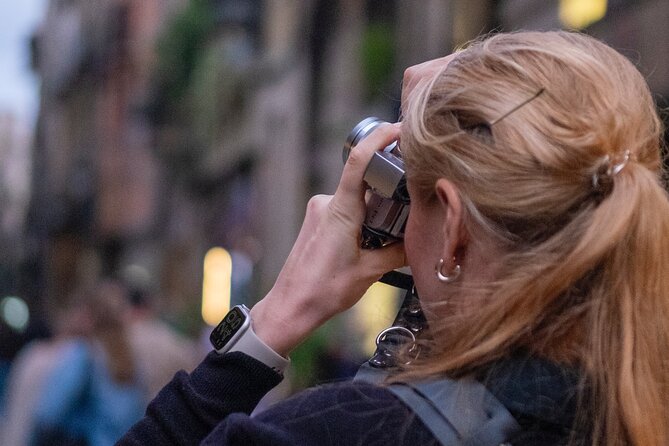
- Small group coaching with up to 10 people, so your questions actually get answered
- Phone-friendly guidance and composition tips for both phones and cameras you bring
- Iconic backdrops close together from Estació de França to Barcelona Cathedral and Plaça Reial
- Free-entry sights at every stop, so you are not juggling tickets in the moment
- A guide like Leonardo who pairs Barcelona stories with photography tricks that make images pop
Why a Gothic Quarter photo walk beats wandering alone
Barcelona has endless photo opportunities, but most people shoot on autopilot. This style of tour aims to fix that fast. You spend about two hours moving between recognizable landmarks, and you get specific guidance for what to frame, where to stand, and how to catch the light so your shots look intentional.
I like that the tour keeps the “equipment” side simple. You do not need a bag of lenses. Your smartphone, used well, can do the job if you know how to angle it, steady it, and compose around the details you see. That is where the value lives, because good phone photos come from decisions, not from megapixels.
You also get a built-in sense of flow through neighborhoods that can feel like a maze on your own. Starting in the Estació de França area and then working toward the Gothic Quarter and El Born means you see the city in a sequence that makes visual sense. The result is you leave with ideas for future trips, not just a stack of landmark photos.
You can also read our reviews of more walking tours in Barcelona

Starting at Estació de França, then moving with purpose
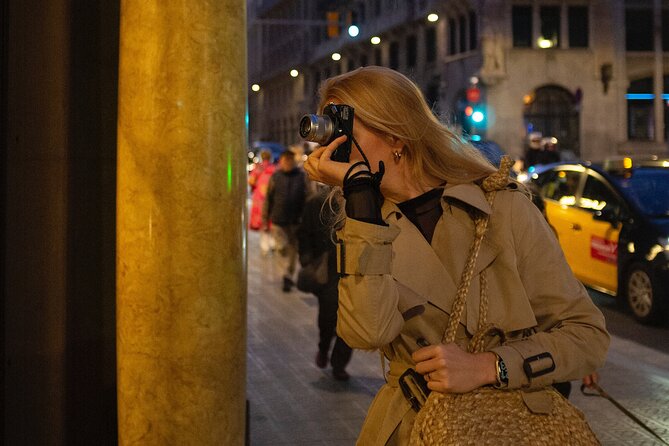
The walk starts at Estación de Francia (Estació de França), Av. del Marquès de l’Argentera, 6. It is a great starting point because it sits near El Born and the harbor area, and it offers architectural lines that are easy to use for street photography.
This first stretch matters for two reasons:
- It helps you get “camera ready.” Many people do not realize how quickly your attention changes when you are hunting for angles instead of landmarks.
- It sets a rhythm for the rest of the walk. You are not randomly popping in and out of spaces. You follow a route that keeps you close to major photo scenes.
Plan for about 10 minutes at the station area. Admission is free for this stop, so you can focus on shooting rather than ticket timing. And since the tour ends back at the meeting point, you get a full loop feeling instead of a one-way shuffle.
Estació de França: elegant architecture, strong lines, easy angles
Estació de França is known for its elegant architecture and historical significance, inaugurated in 1929 to handle railway traffic during the International Exposition of Barcelona. What that means for your photos is you can find clean forms, repeating shapes, and strong “leading lines” that guide the eye.
How to shoot it better on this kind of walk:
- Look for symmetry in the station frontage and stairways.
- Use a low angle when possible to exaggerate the structure.
- When the crowd is thick, shift your framing to corners and partial views, so you still get architecture without constant people in the shot.
If you are using a phone, this is one of the easiest places to practice quick repositioning. Step, reframe, and shoot again. The guide style here is about showing you how to make those small changes matter.
Parc de la Ciutadella and Arc de Triomf: green edges and Neo-Mudéjar drama
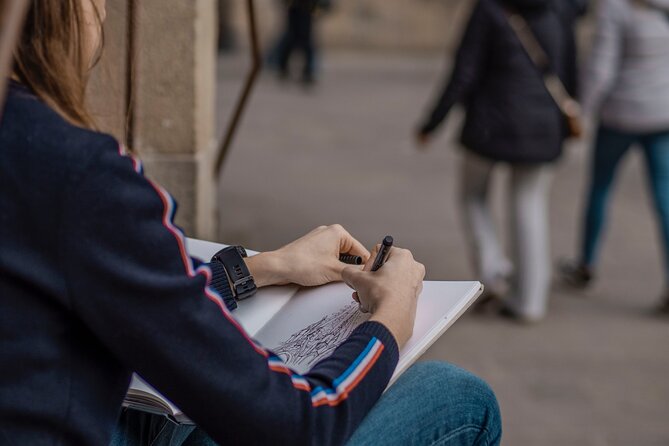
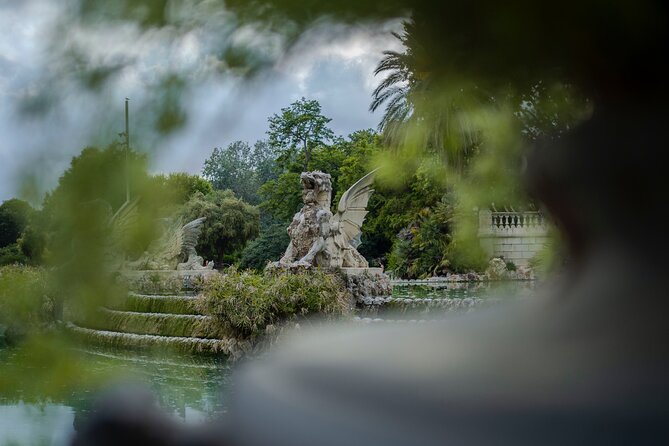
Next up is Parc de la Ciutadella, one of Barcelona’s most iconic parks. It was designed for the 1859 Barcelona Universal Exposition, which explains why the park feels planned, not random. For photos, that is a good thing. You get orderly paths, clear sightlines, and shaded pockets for better light control.
Expect about 20 minutes here. Admission is free, so you can linger at the spots the guide suggests and not worry about timing. If it is bright, use the park’s trees and built edges to break up harsh light. If it is softer, you can chase reflections and textures on paths and stone.
Then you head to Arc de Triomf, built in 1888 for the Universal Exposition. Architecturally, it is a striking example of Neo-Mudéjar style, which tends to reward close attention. The decorative patterns can look busy if you frame too widely, so you will likely get better results by focusing on a smaller section.
A practical photography thought for these two stops:
- Use the park to create “breathing space” shots that give your set variety.
- Use the arc to create a headline image, something with clear structure and a memorable silhouette.
Palau de la Música Catalana: modernisme details you can actually photograph
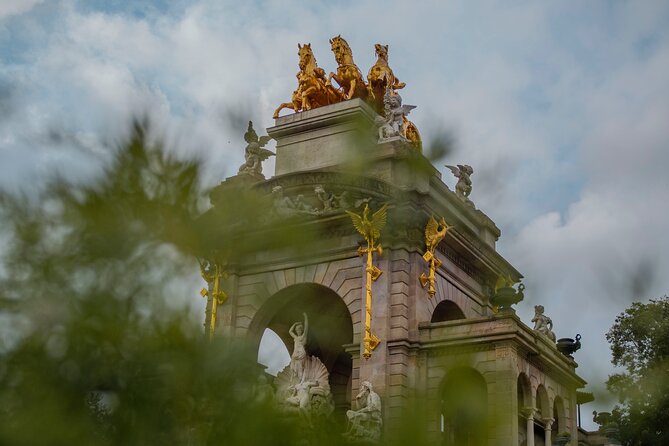
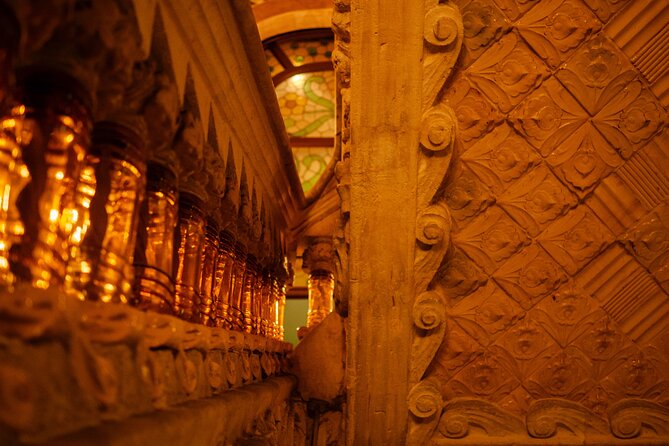
At Palau de la Música Catalana (Palau de la Música Catalana, Carrer Palau de la Música, 4-6), you are in one of Barcelona’s most stunning architectural stops. This Modernisme building was designed by Lluís Domènech i Montaner, and it is the kind of place where you can shoot for a long time, then realize you mostly captured the whole building instead of what makes it special.
You typically get around 10 minutes at this stop. Admission is free, so you can spend that time aiming for details rather than waiting out ticket logistics. The photography challenge here is to avoid “wide-only syndrome.” Instead:
- Frame ornamental elements so they fill most of the image.
- Watch for repeating shapes and patterned surfaces.
- If there is any contrast in the stonework or openings, line your shot so your eye travels through the frame.
This is also a great stop for learning how to “see” architecture. The guide approach described for this tour is to point out intriguing angles that make your pictures look less like tourist snapshots and more like composition.
El Mon Neix En Cada Besada: poetic context at a street-level stop
You also stop at El Mon Neix En Cada Besada in Plaça de Isidre Nonell. The phrase translates to The World Begins in Every Kiss, which signals the vibe: this is not just about grand buildings, it is also about meaning and atmosphere.
You get about 10 minutes, and admission is free. Since the tour moves quickly, treat this as a scene-building break. Look for:
- Faces and body language of passersby (if the moment feels natural)
- Color and texture contrasts in the surrounding area
- A framing that includes a little context rather than cutting everything too tight
This stop is valuable because it balances the heavyweights. After Cathedral and palace-like architecture, you get a chance to shoot something more human and reflective.
Barcelona Cathedral and Casa de l’Ardiaca: gothic shapes, medieval angles
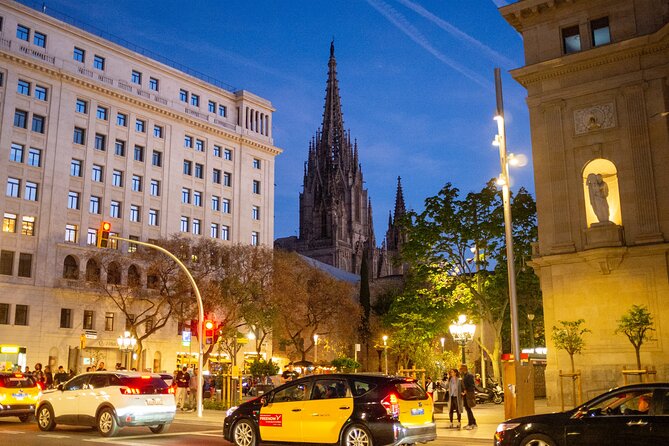
Now you hit Barcelona Cathedral, officially Catedral de la Santa Creu i Santa Eulàlia, in Pla de la Seu within the Gothic Quarter. This is one of the city’s most significant landmarks and a strong example of Gothic architecture. You get about 10 minutes at the stop, and admission is free.
For a quick cathedral photo strategy:
- Stop chasing the entire façade. You usually get better results by focusing on vertical lines, doorways, and window shapes.
- Look for shadows that carve the stone. Gothic buildings love contrast.
- If crowds block your preferred view, shift to side angles or partial views.
Right after, you go to Casa de l’Ardiaca on Carrer de Santa Llúcia, 1. The name Ardiaca refers to the archdeacon, the head of the canons in the medieval cathedral. This stop gives you architectural beauty plus a stronger connection to the religious and civic history of the area.
Photography-wise, smaller buildings like this can be easier if you frame with intention. Instead of trying to capture everything, aim for a composition where you can clearly see:
- stonework details
- arches and openings
- the relationship between the building and street perspective
In this part of the walk, the value is not just the scenery. It is the way the guide pushes you toward angles that work even when you only have a short window.
Pont del Bisbe to Plaça Reial: squares that teach you framing and light
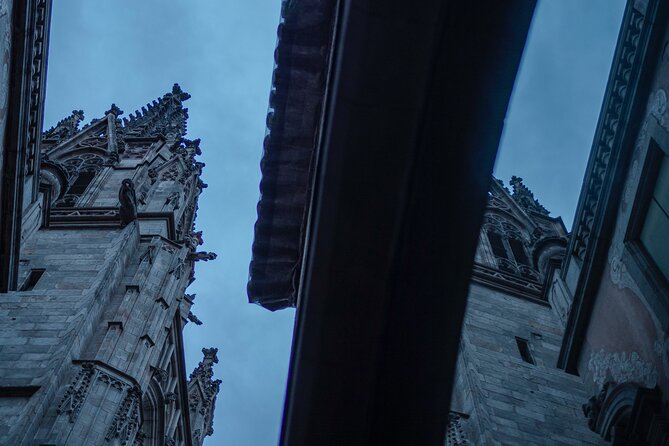
The Gothic Quarter becomes a photo playground when you connect bridges and squares. You visit Pont del Bisbe next. It is one of the most famous and picturesque landmarks here, and it is a Gothic Revival bridge that connects buildings of the Palau de la Generalitat, the government palace of Catalonia.
At Pont del Bisbe, your photos will improve quickly if you:
- Frame the bridge so it leads into the scene on both sides
- Include the stone rhythm and edges, not just the center
- Watch for how light hits the stone and makes lines pop
Then you move to Plaça de Sant Jaume, a historic central square that has played an important role in Barcelona’s history for centuries. It continues to be a focal point for locals and tourists. Expect your guide to help you frame the square so the architecture and space feel balanced, not flattened.
After that, you step into Plaça Sant Miquel, a small but historically significant square. It is calmer and more tranquil, which is exactly what you want after bigger set pieces. Use it for softer, slower compositions:
- try a more intimate frame
- let the square’s quieter feel show up in the shot
- look for perspectives that shrink the scale and make it feel personal
Finally, you end at Plaça Reial, just off La Rambla. It is known for elegant architecture and a lively atmosphere, and it is a must-see if you want your photo set to include energy, not just stone.
This last stretch is where your learned skills really show. You can test:
- how your phone focuses at different distances
- how reflections and shadows change the scene
- how shifting your position slightly can upgrade the photo dramatically
The photo skills you take home, not just the pictures
This tour is built around hands-on learning. It includes individual tips and guidance on how to improve your images, and the best part is that it is tailored for the devices you bring. The tour states you can bring any mobile phone (Android or iPhone) or camera that works for you. That matters because your habits need a fit. A DSLR setup is different from a phone workflow, and the guide approach here is about helping you frame and shoot with what you have.
From the way this tour is described, the main “skills” you walk away with are practical, not abstract:
- How to choose better photo angles instead of aiming straight at the monument
- How to use reflections and reflections-like surfaces when the light helps
- How to frame compositions so they look intentional, even in crowded streets
- How to speed up your decision-making so you are not fumbling with settings mid-walk
If you want a takeaway you can reuse, pay attention to what the guide has you do repeatedly at different stops. When you practice the same technique in multiple settings, it sticks.
Price, timing, and what $59.90 buys you in real terms
The price is $59.90 per person for about 2 hours. On paper, it is not “cheap.” But the value calculation here is pretty clear.
You are paying for:
- a guide’s eyes focused on photography, not just sightseeing
- personalized help in a group capped at 10
- admission-free stops, so your money goes to guidance rather than entry fees
- a route through major places you would otherwise need multiple separate outings to coordinate
It also helps that the tour is offered in English and includes a mobile ticket. You do not need extra paperwork.
Timing is also part of the value. The tour is commonly booked around 41 days in advance on average, which suggests it is popular. If you are traveling in high season or on a tight schedule, booking earlier can reduce your chances of missing your preferred time slot.
One more real-world factor: the experience requires good weather. If the day is rainy or miserable, it may not run as planned, and you might need an alternate date.
Should you book the Photo Walking Tour in Barcelona Cathedral, Gothic Quarter, and El Born?
Book it if you:
- want your phone photos to look more deliberate fast
- like getting practical camera guidance while you walk
- enjoy mixing Gothic Quarter classics with El Born energy and Modernisme architecture
- prefer a small group experience where you can ask questions
Skip it (or at least adjust expectations) if:
- you arrive without a working phone or camera, because the tour does not provide equipment
- you want long, slow museum time at each stop, because this is a short, photo-focused route
One smart precaution: arrive early and be ready to start on time at Estación de Francia. While things can go wrong anywhere, it is worth being proactive about your day-of timing. This tour also can include emails of tour photos in certain cases if something disrupts the session, but I would not plan on that as your safety net.
If you want a concise way to learn Barcelona photography while covering the biggest hits around Barcelona Cathedral, El Born, and the Gothic Quarter, this is a solid bet for the price.
FAQ
How long is the Barcelona Cathedral Gothic Quarter El Born photo walking tour?
It is listed as about 2 hours.
What is the price per person?
The price is $59.90 per person.
Is the tour offered in English?
Yes, it is offered in English.
Do I need to bring my own phone or camera?
Yes. The tour does not provide camera equipment. You should bring a mobile phone or a camera that works for you.
How many people are in the group?
The tour has a maximum of 10 travelers.
Where does the tour start?
The start point is Estación de Francia, Av. del Marquès de l’Argentera, 6, Ciutat Vella, 08003 Barcelona, Spain.
Does the tour include admission tickets?
All listed stops note admission ticket free, and the tour is focused on guidance and photography.
Are food and drinks included?
No. Food and drinks are not included.
What happens if the weather is poor?
The experience requires good weather. If it is canceled due to poor weather, you will be offered a different date or a full refund.
More Walking Tours in Barcelona
More Tours in Barcelona


More Tour Reviews in Barcelona
Not for you? Here's more nearby things to do in Barcelona we have reviewed






More Gothic Quarter Tours worth opening.
 ★ 5.0Barcelona Gothic Quarter Tapas & Taverns Food & Wine TourFrom $1311,470 reviews
 ★ 4.7Gothic Quarter Ghosts and Legends Walking TourFrom $191,443 reviews
 ★ 4.8Old Town and Gothic Quarter Walking TourFrom $211,393 reviews
 ★ 5.0Barcelona Old Town & Gothic Quarter Small Group TourFrom $221,308 reviews
 ★ 4.8El Born and Gothic Quarter Wine & Tapas Bar TourFrom $81674 reviews
 ★ 5.0Kids and Family Gothic Quarter Walking Tour in BarcelonaFrom $25465 reviews
 ★ 4.5Barcelona Gothic Quarter Walking TourFrom $33456 reviews
★ 4.9Gothic Quarter Walking TourFrom $212383 reviews
★ 4.5Barcelona Gothic Quarter Walking TourFrom $33456 reviews
★ 4.9Gothic Quarter Walking TourFrom $212383 reviews
Continue by place or experience