
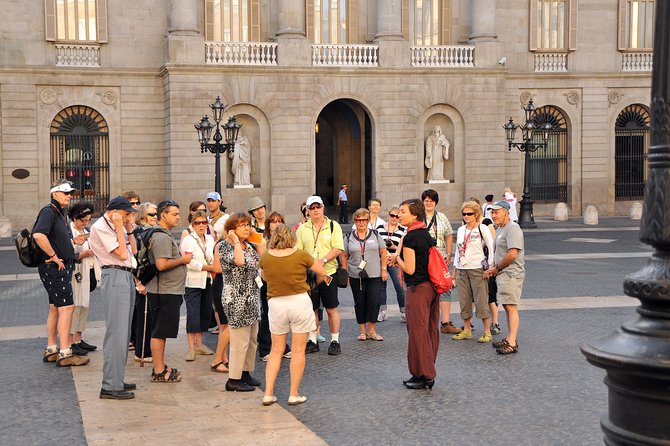
REVIEW · GOTHIC QUARTER TOURS
Barcelona: Gothic Quarter Walking Tour
Old stones, clear stories, on foot. This 2-hour Gothic Quarter walk strings together Roman remains and medieval lanes, plus the big sights around Ciutat Vella. I love how the guide explains what you are looking at, and I also like the way the route bounces between major landmarks and everyday backstreets.
On one Italian-language outing, Adele was praised for sharing history and practical restaurant ideas, and French- and Spanish-speaking groups similarly highlighted guides like Teresa for passion and clarity. One drawback to plan for: with 2 hours, you will skim each landmark, and food and drink are not included, so think quick stops and then eat on your own after.
Key points I’d plan around
- Roman remains show up right in the streets so the quarter feels layered, not just decorative
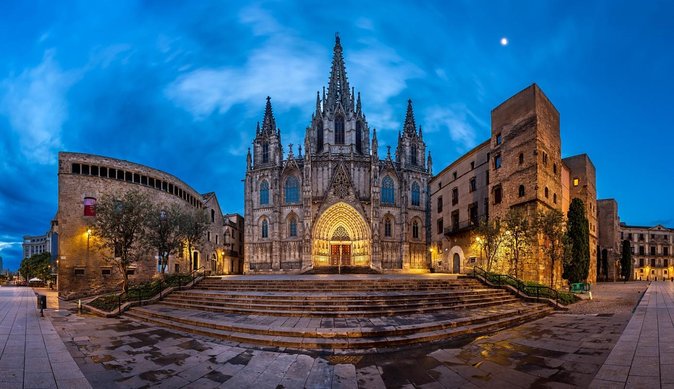
- Barcelona Cathedral is a must for its famous gargoyle sculptures and Gothic presence
- Las Ramblas plus Mercat de la Boqueria gives you a smart “see it, taste it later” combo
- Plaça Reial is a relaxing visual pause, not another hard march
- El Born and Santa Maria del Mar connect old Catalan building style to neighborhood pride
Where this walk begins: Pl. d’Urquinaona to Ciutat Vella
The tour starts at Pl. d’Urquinaona, 6. That matters because you are launching close to the old-town web, so you do not waste time crossing the city first. In practice, it also means you start with the right mindset: this is a walking tour through compact, turning streets, not a bus-and-stop sightseeing day.
You are also set up for a common Gothic Quarter problem, getting lost. With an expert guide, you get a route that makes the neighborhood feel logical. Instead of randomly picking your way through alleys, you learn why the streets are where they are and how the quarter evolved from earlier eras into what you see now.
You can also read our reviews of more walking tours in Barcelona



Roman remains to medieval alley logic
The heart of the experience is the shift in time layers. You are walking a neighborhood where Roman remains are scattered throughout the area. That is a big deal, because it changes the way you read the streets. You start spotting the neighborhood as a timeline, not just a pretty postcard.
As the route moves through the Gothic Quarter, your guide’s job is to connect those Roman traces to the medieval growth that followed. The medieval character is not only the big architecture. It is also the pattern of narrow lanes and the way the area can feel like a labyrinth. When that clicks, you stop treating the quarter like a maze and start using it like a map.
A helpful tip for your side: wear shoes you trust. The tour is 2 hours, so you will cover ground at walking speed, and medieval streets often mean uneven pavement. Comfortable shoes are listed for a reason.
Las Ramblas and the Boqueria reality check
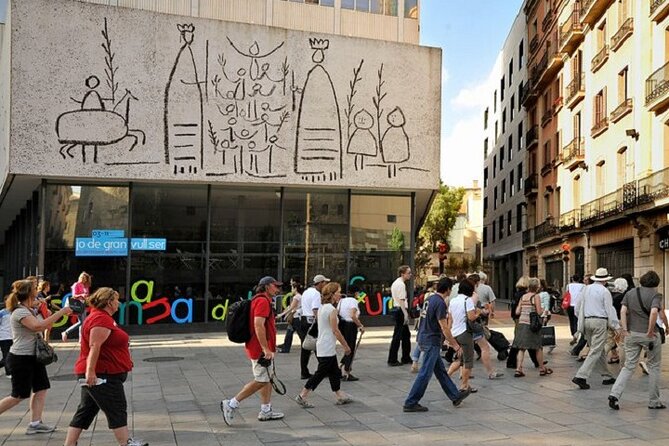
From the backstreets, the route heads toward Las Ramblas. This is the part of the city where people-watchers thrive and street life takes over. You walk along the famous avenue with bars, restaurants, and street artists in the mix, and the guide’s commentary helps you avoid treating it as just a tourist strip.
Then you get to Mercat de la Boqueria. This is one of those places you can understand fast, even if you do not plan to overbuy. The market is described as bustling with life, color, and gastronomic delights. The real value of including it on a guided walking tour is that you see it with context, not as a loud free-for-all.
One practical way to handle it: come hungry enough to enjoy the sights, but do not assume the tour price covers food. Food and drink are not included, so this is a great place to window-shop for flavors, then pick your meal after the tour when you have time to sit.
Plaça Reial: a breather inside the old city
After all the movement, Plaça Reial gives you a calmer visual break. It is described as a Napoleonic-era square that attracts artists and travelers. That combination is why it works: you get open space, people flow, and a classic old-city square vibe without having to keep walking.
I like this stop because it prevents the common “Gothic Quarter burnout.” If your day is too back-to-back, you stop absorbing details. A square like this gives your brain a chance to reset, and then you can focus again on the next architecture-heavy moments.
Barcelona Cathedral and those gargoyle sculptures
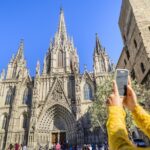
The tour includes Barcelona Cathedral, and it calls out the gargoyle sculptures as a signature feature. This is one of those sights where a guide helps a lot. Without context, it is easy to stare at the stone faces and call it decoration. With context, you start seeing how Gothic design uses sculpture to make the building feel alive and expressive.
If you are the kind of traveler who likes details, you will probably enjoy slow glancing during this section. If you are more “big picture only,” you still get something worth your time because the cathedral’s scale and silhouette are hard to miss even from partial views.
Important reality check: because the overall tour is 2 hours, your cathedral time is not going to be a long, sit-down museum visit. It is more like a guided hit that tells you what to notice, so you can continue exploring later if you want.
El Born: old and new side by side
Next comes El Born. This neighborhood is described as blending old and new. That’s a useful thing to know because El Born can feel different from the Gothic core. Instead of only centuries-old texture, you see how the city keeps reinventing the street life.
I find El Born helpful because it acts like a bridge. The Gothic Quarter can be heavy on medieval mood. El Born gives you a sense of how Barcelona works today, while still staying connected to older buildings and street forms.
If you enjoy markets, galleries, and walking just to see what people are doing, this part can be extra satisfying. Even if you just use it as a transition, it keeps the tour from feeling like a repeat of the same stone-and-staircase scenes.
Santa Maria del Mar: Catalan Gothic built by locals
The tour ends with St. Mary of the Sea Cathedral, also known as Basilica de Santa Maria del Mar. The standout detail here is how it is described: a stunning example of Catalan Gothic architecture built by the people of the neighborhood themselves.
That detail changes the emotional tone of the visit. You stop thinking of the basilica as an unreachable monument funded by outsiders. Instead, you picture community effort, local builders, and a shared investment in a place of worship. It gives the building more meaning than just its visual style.
Like the cathedral earlier, this is not positioned as a long, independent deep dive. It is part of a route that stays focused on what you can absorb in a short window. But even with that pace, the idea of neighborhood-built Catalan Gothic is memorable, and it gives you something to carry into your own exploring afterward.
Price and value for a $29, 2-hour route
At $29 per person for a 2-hour guided walk, the value comes from two things you get in the same package: expert guidance and access to several major stops without spending your whole day stitching them together.
Included on the tour side:
- A guide (customizable experience)
- The route coverage that hits the Gothic Quarter core, Las Ramblas, Mercat de la Boqueria, Plaça Reial, Barcelona Cathedral, El Born, and Santa Maria del Mar
Not included:
- Food and drink
So the smartest way to judge the price is not as a “cheap add-on.” It is closer to a time-saving tool. You pay to reduce confusion, get context fast, and see the key landmarks without trying to build the best route yourself while you are tired.
If you want a slow day where you linger for hours inside one site, you might feel limited by the 2-hour pace. If you want an efficient orientation that makes the rest of your time in Barcelona easier, this price starts to look fair.
Pace, group setup, and how to get the most out of it
This tour is designed for walking efficiency. Expect to cover multiple neighborhoods and landmarks in a compact time window. That is good for first-time orientation, but it means you should protect your energy and keep your expectations realistic: you are getting guided highlights, not a full, unhurried museum schedule.
The tour is also described as customizable, which is a helpful detail for groups who want slightly different emphasis. If you book a private group, that customization can matter even more.
Language options are listed as English, French, Italian, and Spanish. In the reviews, you can see that guides like Teresa and Adele left strong impressions for delivering history in a way people could follow. That is the kind of quality that makes a difference on a street-level walking tour.
Who this tour suits best
This is the kind of outing that works especially well if you:
- Want a structured way to see the Gothic Quarter without constantly getting turned around
- Like architecture plus street-level context, not just random photos
- Plan to spend the rest of your day eating and wandering at your own pace
- Are visiting for the first time and want an organized orientation
It may be less ideal if you want long time inside major sites, or if you expect the market stop to come with food included. Because food and drink are not part of the tour, you will want to plan meals separately.
Final decision: should you book this Gothic Quarter walking tour?
I think this is a smart booking if you want the Gothic Quarter to make sense quickly. The combination of Roman remains, medieval alley storytelling, and major sights like Barcelona Cathedral and Santa Maria del Mar gives you a guided framework you can reuse all week.
Book it if you are happy with a highlight-style pace and you want a guide to point out what to notice. Skip it only if you prefer self-guided wandering with no structure, or if you need food included in your ticket price.
If you do book, I’d show up with two simple priorities: comfortable shoes and the mindset that the best part is learning how the neighborhood layers on top of itself. Then you can turn the rest of your time in Barcelona into slower, more personal exploring.
FAQ
Where does the tour start?
The tour starts at Pl. d’Urquinaona, 6.
How long is the Gothic Quarter walking tour?
It lasts 2 hours.
Is food or drink included in the tour price?
No. Food and drink are not included.
What languages is the live guide available in?
The tour guide is available in English, French, Italian, and Spanish.
Is the tour wheelchair accessible?
Yes, the tour is listed as wheelchair accessible.
What should I bring for the walk?
Comfortable shoes are recommended.
Is there free cancellation, and can I pay later?
Yes. There is free cancellation up to 24 hours in advance for a full refund, and you can reserve now and pay later.
More Walking Tours in Barcelona


More Tours in Barcelona


More Tour Reviews in Barcelona
Not for you? Here's more nearby things to do in Barcelona we have reviewed








More Gothic Quarter Tours worth opening.
 ★ 5.0Barcelona Gothic Quarter Tapas & Taverns Food & Wine TourFrom $1311,470 reviews
 ★ 4.7Gothic Quarter Ghosts and Legends Walking TourFrom $191,443 reviews
 ★ 4.8Old Town and Gothic Quarter Walking TourFrom $211,393 reviews
 ★ 5.0Barcelona Old Town & Gothic Quarter Small Group TourFrom $221,308 reviews
 ★ 4.8El Born and Gothic Quarter Wine & Tapas Bar TourFrom $81674 reviews
 ★ 5.0Kids and Family Gothic Quarter Walking Tour in BarcelonaFrom $25465 reviews
 ★ 4.5Barcelona Gothic Quarter Walking TourFrom $33456 reviews
★ 4.9Gothic Quarter Walking TourFrom $212383 reviews
★ 4.5Barcelona Gothic Quarter Walking TourFrom $33456 reviews
★ 4.9Gothic Quarter Walking TourFrom $212383 reviews
Continue by place or experience