
REVIEW · GOTHIC QUARTER TOURS
Gothic Quarter Barcelona Tour with Audioguide
Skip the mob, wander the Gothic Quarter. This self-guided walk gives you the key sights in Barcelona without herding anyone into a group pace, starting from Plaça de Catalunya and moving through the old streets and waterfront. I like the offline map setup because it keeps you oriented as you hop between monuments.
The route focuses on what you can actually see, from Parroquia Santa Anna’s medieval calm to the big visual landmarks like Barcelona Cathedral and the Palau de la Generalitat de Catalunya. You also get 21 audio recordings plus illustrations so you can match what the narration is talking about to what’s in front of you, even when signage is less than helpful.
One drawback to plan for: this is audio-only, so you’ll need your own headphones and you’ll be staring at your phone map more than you would on a guided tour. If you hate tech during sightseeing, it may feel like work instead of fun.
Key highlights worth your time
- Self-guided pace through the Gothic Quarter so you can slow down for photos and still keep moving
- Offline map GPS navigation that helps you find each stop without guesswork
- 21 audio stories in English, designed for short sightseeing moments
- Illustrations to recognize landmarks, helpful in tight medieval streets
- A smart route arc, from Plaça de Catalunya to La Rambla and out toward Port Vell
- One-year access to the audio content after booking
How the self-guided audio format works in Barcelona
This experience is built for an easy “turn-by-turn in your ears” style. There is no live guide meeting you, and you won’t be following a person with a megaphone. Instead, you download the TouringBee audio guide app for iPhone or Android, activate your purchase, then follow the route on the mobile map.
What I like about this format is that it gives you control. In the Gothic Quarter, a lot of the magic is in the small turns and the slow look at details. A group tour is great when you want context fast, but it can also mean you keep catching up. Here, you can linger when something catches your eye, then hit the next stop when you’re ready.
The audio comes with offline map support and route guidance. That matters because Barcelona’s center is busy, and it is easy to feel directionally “busy” too. Offline navigation is the difference between sightseeing and constantly recalculating where you are.
The audio is available in English, and you get a set of 21 recordings. The tour also includes illustrations, which is a practical touch. When you are standing in a Gothic streetscape, it helps to have an image prompt for what to look at, not just a description.
You can also read our reviews of more tours and experiences in Barcelona.
Starting at Plaça de Catalunya, then cutting into medieval lanes
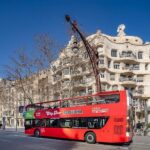
Your walk begins at Plaça de Catalunya in Barcelona’s Eixample area. This square is a real connector. It links the Old Town feel to the more modern, street-grid vibe of Eixample, so you can treat it like your mental reset button before the Gothic streets.
Plaça de Catalunya is described as energetic and full of everyday life. Fountains, greenery, and sculptures give you a visual “orientation moment” before the architecture turns older and denser. Also, since it is a major transit hub, it is a sensible place to start when you are planning the rest of your day in Barcelona.
A big value here is that you are not just starting somewhere random. The route is laid out to help you build a sense of where you are in the city. You begin with the anchor square, then the route pushes you toward the Gothic Quarter’s monuments and lanes.
Practical tip: because this is audio-guided, your best experience comes from moving at a steady pace rather than sprinting between stops. The narration is paced for short visits, so if you spend too long wandering off-script, you can feel like you are constantly catching up.
Parroquia Santa Anna and Barcelona Cathedral, two types of Gothic impact
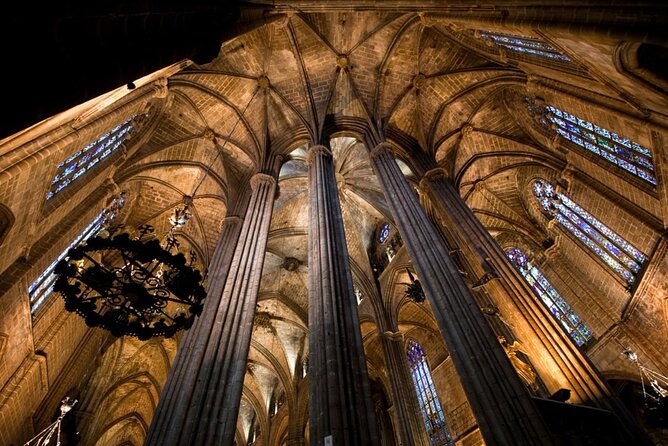
Parroquia Santa Anna is described as a hidden, medieval-feeling church in the Gothic Quarter. Step inside and the tone changes. This is one of those places where the outside bustle fades and you get to experience the quiet side of the old city. The narration calls out the 12th-century roots and the Gothic architecture, plus stained glass windows.
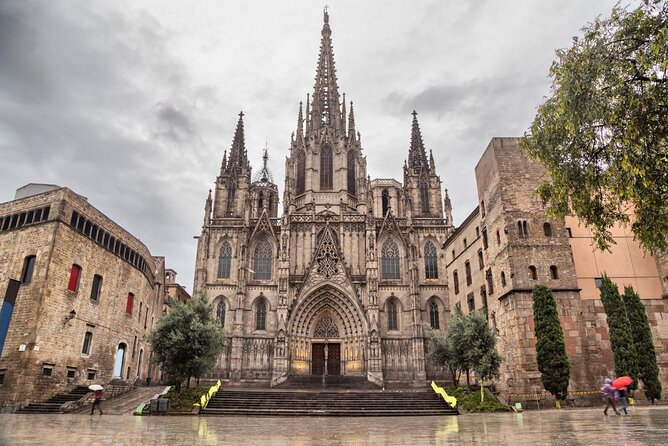
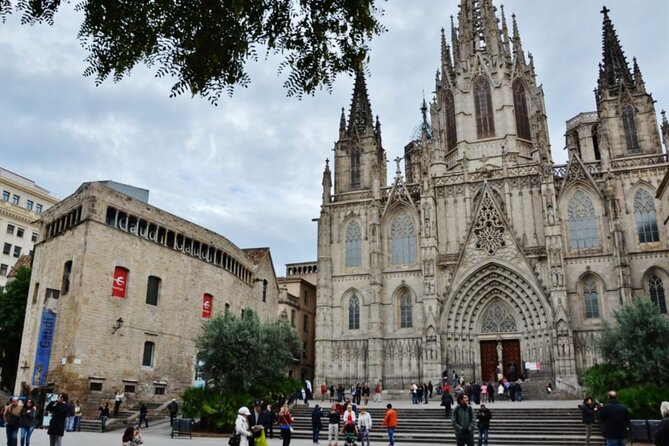
Then you hit Barcelona Cathedral, the big one. This is an architectural masterpiece with Gothic and neo-Gothic elements. The stop focuses on the cathedral’s intricate facades and the calmer feel of its cloister. The audio also points you toward the cathedral’s chapels and includes the idea of getting a panoramic view from the bell tower.
Here is the balance: Parroquia Santa Anna is about atmosphere and scale. Barcelona Cathedral is about grandeur and visual complexity. If you only visit one religious site, you might miss one side of the story. This route is trying to give you both in one run.
Keep in mind that entrances to specific areas, like viewpoints, are not included in the price. The audio can guide you toward what’s worth your time, but your cost depends on what you choose to enter.
Palau Reial Major and Palau de la Generalitat, where power shows in stone
After the cathedral zone, the route swings toward the Palau Reial Major. This palace is presented as a historic hub for Barcelona’s counts and the kings of Aragon. The narration emphasizes medieval architecture, courtyards, and the Saló del Tinell, a setting tied to important events.
This stop helps you see how Gothic Barcelona was not only about churches. It was also about governance, wealth, and major ceremonies. You get a more political view of the city’s architecture.
Next comes the Palau de la Generalitat de Catalunya. This is Catalonia’s seat of government, and the audio focuses on its Gothic façade and inner courtyard. You’ll also hear about the Saló de Sant Jordi, described as a symbol of Catalan autonomy.
If you like the idea of architecture as a historical document, this pair of palace stops is a strong moment. One gives you medieval royal power. The other gives you regional political identity in the present. Even if you do not read every plaque, the audio’s framing helps your brain connect the visual cues to what they meant.
Plaça Sant Felip Neri and Santa Maria del Pi for quieter contrast
Plaça Sant Felip Neri is described as a serene oasis. The audio points to a Romanesque church and notes visible scars from the Spanish Civil War on the church walls. That combination makes this stop feel more reflective than postcard-perfect.
Then Santa Maria del Pi shifts you back into skyline territory. The narration calls out its soaring spires and a rose window. This is a 14th-century basilica, and the audio highlights the interior and encourages you to climb the bell tower for city views.
The contrast is useful. When your day starts with “big landmark eyes,” it is easy to burn out. These two stops act like emotional punctuation marks. One is calm and historically heavy. The other is visually dramatic and view-focused.
Again, viewpoint access might involve paid entry, and entrances are not included in the tour price. But the audio still gives you something valuable even if you only enjoy the exterior and the main spaces you can access freely.


La Rambla and Mercat de la Boqueria, your lively breaks in the middle
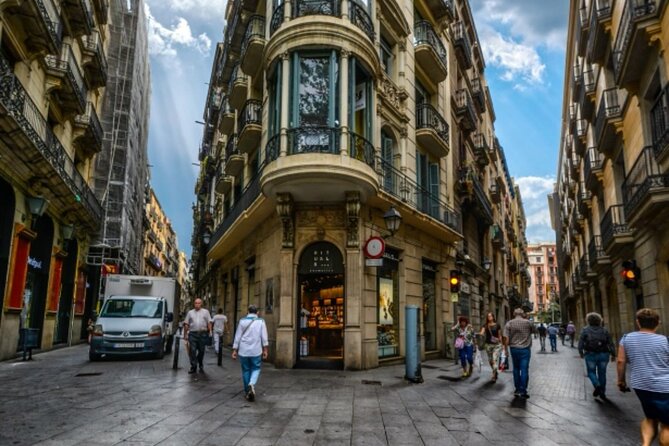
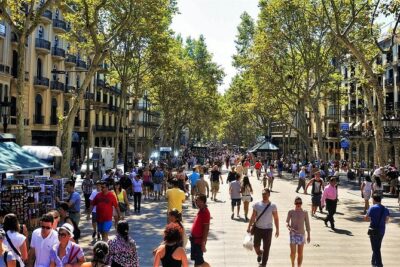
After the quieter squares and churches, the route reaches La Rambla. This is the famous boulevard where Barcelona feels loud, social, and constant. The audio frames it with shops, cafes, and street performers, so you get context as you walk rather than just visual chaos.
La Rambla also feeds directly into Mercat de Sant Josep de la Boqueria. The market is described as a culinary paradise with fresh produce, seafood, cured meats, and local delicacies. You are given a sensory assignment, to look, then to snack if you want, and to understand why this market is such a Barcelona anchor.
You should treat this part as a break from “architecture brain.” If you have been reading the city through stone details, markets are your reset. They also help keep the self-guided experience lively because it includes a natural pause point.
Food and drinks are not included. But even if you skip eating, the market stop is still worth it for the people-watching and the visual variety.
Plaça Reial, Mirador de Colom, and the walk toward the waterfront
Plaça Reial comes next, and it’s described as enchanting with palm trees and Mediterranean charm. The narration connects it to cafes and restaurants and mentions the iconic Gaudí lampposts. It also points out that the square comes alive at night, which is a good note if you are building a longer day plan after this route.
From there, you reach Mirador de Colom, the Columbus Monument area. The audio tells you that you can take an elevator to the top for panoramic views of the city and the Mediterranean. It also mentions an exhibition room with history.
This stop is a classic “do you want the view” moment. If you like skyline moments and want to understand the city’s shape, it is a great use of time. If you would rather keep moving, you can still enjoy the monument area while planning your budget for any elevator or exhibition access.
Maritime Museum to Port Vell, then Rambla de Mar as the soft landing
The next chapter is the sea. The audio includes the Maritime Museum, housed in a medieval shipyard. It highlights ship replicas, navigational instruments, and maritime art, all focused on Barcelona’s seafaring heritage. This is a different angle on the city, one that explains why Barcelona grew the way it did.
Then the route hits Port Vell, the old port. You’ll find a palm-lined promenade, views of superyachts, and the option to enjoy fresh seafood at waterfront restaurants. The audio also calls out nearby ideas like Barcelona Aquarium, the Maremagnum mall, and Barceloneta Beach.
One thing I appreciate about adding Port Vell is that it gives you a clear end-of-day mood. After Gothic streets and market crowds, the waterfront feels like a natural decompression area. Even if you do not stay long, you end with open space and sea air vibes.
Finally, the route includes Rambla de Mar, a wooden footbridge described as a gateway to Barcelona’s maritime world. The audio mentions an undulating path, restaurants and shops along the way, and views back toward Port Vell and the Mediterranean. You can also catch a boat tour from here if you want to extend the day.
This finish works because it’s a gentle, scenic walk. It is a nice way to end a self-guided experience without needing one more massive “must-see” inside a building.
Price and value: why 8.27 per person can be a smart buy
At $8.27 per person, this is priced like an inexpensive accessory to your day. The key question is what you actually get for that cost.
You get a full audio app for iPhone or Android, an offline map with route guidance, 21 audio recordings, illustrations to help you identify landmarks, and one year of access to the tour in your chosen language. That is a lot of “attention” for a small price, especially if you prefer to walk without being tied to a group schedule.
It can be especially good value if:
- You want to explore the Gothic Quarter without constant crowd management
- You like having context as you walk
- You are the type who forgets to read signs but pays attention to spoken explanations
Where it might be less of a fit:
- You dislike using a phone for navigation and audio
- You plan to skip most stops because you are trying to cover too much in one day
Think of it as buying a local storyteller for your walk. If you like that style, the price makes sense.
Included vs. not included, so you do not get surprised
Included:
- Audio guide app for iPhone and Android
- Offline map with GPS navigation
- 21 audio recordings about sights in Barcelona
- Illustrations to recognize landmarks
- One-year access
Not included:
- Food and drinks
- Entrance fee or tickets
That last line matters for the cathedral, the bell tower option, and any paid viewpoints tied to monuments and museums. The route will guide you to the ideas, but you choose whether you want to pay for specific interior access.
Timing, route length, and where you will feel the pace
The experience is listed as about 1 hour 30 minutes. Many stops on the route are designed for quick visits, so the narration does not assume you are spending half the day inside buildings.
If you are the type who likes reading every sign, you might spend longer than the estimate. If you keep moving and treat most stops as short listen-and-look moments, the route can feel efficient.
The activity starts and ends back at Plaça de Catalunya. That makes it easy to plan your next activity nearby, since you are not stuck in some random out-of-the-way finish point.
The tour is also near public transportation, which helps when you are building a day that includes other parts of Barcelona.
Who this Gothic Quarter audio tour is best for
This works best for you if you want a self-guided Barcelona center walk that still has structure and stories. It is a good match if you want to avoid group-touring crowds and enjoy narrow lanes with your own rhythm.
It also suits:
- Solo travelers who want independence
- Couples or friends who do not want to wait for each other
- People who like architecture and want spoken context instead of reading walls of text
It might not be ideal if you strongly prefer human-guided explanations, because there is no person leading you. It is also less ideal if you hate phone-based navigation, since the app map is part of the experience.
Should you book this Gothic Quarter tour with audio?
Yes, if you want an easy way to connect the dots across Gothic Quarter landmarks, La Rambla, the market, and the Port Vell waterfront in a single session. For the price, you get an organized route plus audio context that turns “I’m walking around” into “I’m understanding what I’m looking at.”
I’d skip booking only if you know you will not use the audio app during the walk, or if you plan to do so many paid-entry sites that you can justify a more expensive guided day instead. Otherwise, this is a smart, low-stress way to experience central Barcelona at your pace, with stories timed for walking.
FAQ
Where does the tour start and end?
The tour starts at Plaça de Catalunya, Eixample, 08002 Barcelona, Spain. It ends back at the same meeting point.
How long is the Gothic Quarter Barcelona Tour with audioguide?
The duration is approximately 1 hour 30 minutes.
Is this tour guided by a person?
No. It is self-guided. You’ll use the TouringBee mobile app, activate your purchase, and follow the route on the mobile app map with no human guide.
What do I need to bring?
You should bring your own headphones, since they are not included.
What is included in the $8.27 per person price?
The price includes the audio guide app for iPhone and Android, an offline map with route navigation, 21 audio recordings, illustrations to recognize landmarks, and 1 year access in the language you choose. Food and drinks and entrance fees are not included.
Can I cancel for a full refund?
Yes, you can cancel for free up to 24 hours in advance for a full refund. If you cancel less than 24 hours before the start time, the amount you paid will not be refunded.
More Tours in Barcelona
More Tour Reviews in Barcelona
Not for you? Here's more nearby things to do in Barcelona we have reviewed








More Gothic Quarter Tours worth opening.
 ★ 5.0Barcelona Gothic Quarter Tapas & Taverns Food & Wine TourFrom $1311,470 reviews
 ★ 4.7Gothic Quarter Ghosts and Legends Walking TourFrom $191,443 reviews
 ★ 4.8Old Town and Gothic Quarter Walking TourFrom $211,393 reviews
 ★ 5.0Barcelona Old Town & Gothic Quarter Small Group TourFrom $221,308 reviews
 ★ 4.8El Born and Gothic Quarter Wine & Tapas Bar TourFrom $81674 reviews
 ★ 5.0Kids and Family Gothic Quarter Walking Tour in BarcelonaFrom $25465 reviews
 ★ 4.5Barcelona Gothic Quarter Walking TourFrom $33456 reviews
★ 4.9Gothic Quarter Walking TourFrom $212383 reviews
Continue by place or experience