
REVIEW · BARCELONA CITY TOURS
Barcelona City Tour Hop-On Hop-Off with Optional Boat
Barcelona is best when you can move at your own pace, and this tour makes that easy. You’ll ride a double-decker hop-on hop-off bus through the city’s main sights, with multilingual audio that helps you match streets to stories. The optional 1-hour catamaran adds a second angle on Barcelona’s harbor and coastline.
I especially like the interconnecting east and west routes on one ticket. You can get off for the big Gaudí landmarks, then hop back on when your feet need a break, without buying separate tours. I also like that the audio is available in English and other languages, so even if you arrive jet-lagged, you can still follow what you’re seeing.
One drawback to think about: the catamaran part depends on a tight sailing schedule, and weather can complicate getting to the boat stop on time. If you hate having your day “managed” by departure times, consider skipping the boat add-on and just enjoy the bus.
Key things to know before you ride
- Two linked routes, one ticket: Hop on and off across both the east and west routes from the same pass.
- Flexible validity windows: You choose a 24-hour or 48-hour pass, and the 48-hour option must be used on consecutive days.
- Gaudí on the east route: Sagrada Familia, Park Güell, La Pedrera, and Casa Batlló are part of the loop.
- Old city and Montjuïc area on the west route: You’ll pass through areas like the Born and Montjuïc, plus the harbor side.
- Optional 1-hour coastal cruise: If you upgrade, you’ll board from the harbor area, with pick-up points like Arc de Triomf and Passeig de Colom.
- Headset audio designed for more than one hearing need: Some seats use a multilingual looping system with headphones and no wires.
Barcelona hop-on hop-off in real life, not just a bus loop
This kind of tour works in Barcelona because distances can be tricky. You can do a lot from the street level, but the city is spread out, hills happen, and you do not want to waste your first day bargaining with transit apps.
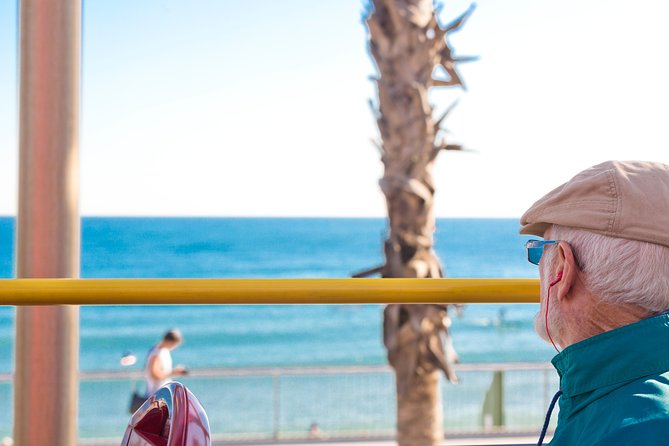
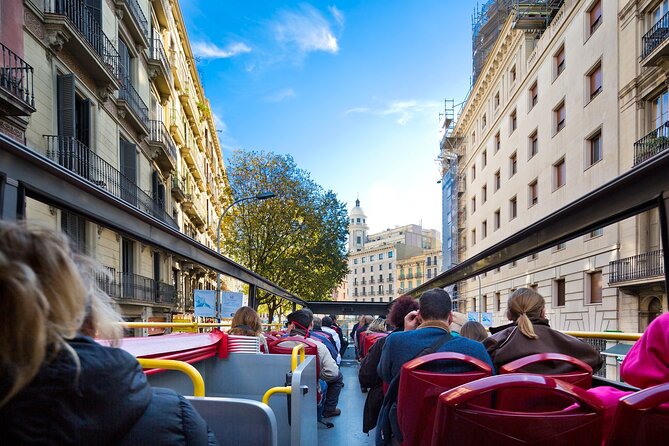
The bus itself is built for sightseeing. The top deck is where the views happen, with plenty of riders aiming for that “first look” angle at the skyline and the sea. When weather turns messy, you still have a plan, since the buses offer covered seating up top. And yes, seats can feel a bit tight when the bus fills up, which is true of most double-decker sightseeing buses.
The tour is also designed around your day, not theirs. You can start at convenient stops on either route, ride for as long as your pass allows, and repeat sections if there’s something you want to stare at longer.
You can also read our reviews of more boat tours in Barcelona

What makes it feel worth the ticket
You’re not just getting “a ride.” You’re getting a moving map with commentary. The audio system guides you through what you can see along the way, and it’s offered in multiple languages, including English.
Also, you’re not limited to one side of town. The east route focuses on Gaudí landmarks and major scenic backdrops, while the west route adds older neighborhoods, museums, and port areas. Since the routes connect through shared stops and the same ticket, you can tailor your mix.
The east route: Gaudí power stops you can plan around
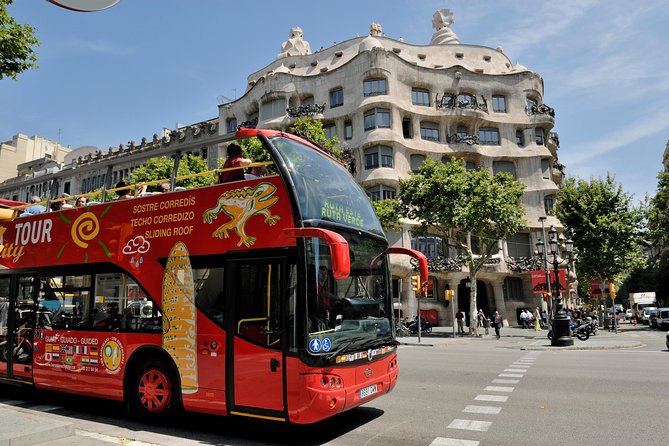
If you want the Barcelona postcard highlights, the east route is your backbone. This is the section that makes most people smile when they hear the names.
Here’s how the key stops work for your planning, starting from the waterfront side and moving toward the Gaudí cluster.
Pla de Palau and the waterfront intro
You’ll start around Pla de Palau, a handy launch point near the city’s older center and close enough to the harbor vibe. The bus keeps the city readable, so even if you don’t get off here, you’ll understand where you are relative to the water.
From there, you roll toward the Passeig Marítim de la Barceloneta and the beach strip. This is great for orientation. If you’ve been walking all day, you can also just enjoy the views and let the bus do the climbing.
Barceloneta to Bogatell: beach and skyline views
Stops include Av. d’Icària, 170, and Platja Bogatell. These are useful for two reasons. First, they help you see how Barcelona’s coastline shifts from one “feel” to another. Second, they give you a place to drop off if you decide you want sand time later.
You can also read our reviews of more city tours in Barcelona





The modern city blocks and Torre Glòries
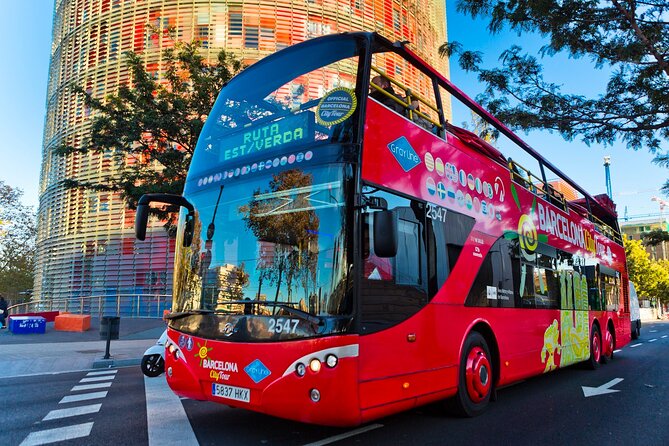
As you head along Carrer de Bac de Roda & Passeig de Garcia Fària, the route also brushes past modern Barcelona energy. A standout viewpoint stop is Mirador Torre Glòries. If you like city viewpoints, this can help you understand the contrast between contemporary architecture and Gaudí’s style.
Sant Pau: a stunning break from pure sightseeing
Next comes Recinte Modernista de Sant Pau. Even if you only pause for a look, this area gives you a “Barcelona beyond Gaudí” moment. It’s a smart stop for people who don’t want their whole day to be one architectural style.
Park Güell: the stop you should time smart
Then you reach Park Güell. A real-world note: the bus stop can be set a few blocks away from the entrance, and it can mean some uphill walking. That makes it less ideal if you’re trying to hit strict timed-entry tickets. If you’re visiting in the busiest season when timed entry is common, you may want to treat Park Güell as a main event, not a quick stop.
La Pedrera (Casa Milà) and Casa Batlló: the best “check them off” combo
You’ll hit La Pedrera – Casa Milà, then Casa Batlló. These are two of the most photographed Gaudí buildings, and they work well on a hop-on hop-off plan because you can jump off, take photos, and still stay flexible if you decide you want more time elsewhere.
Barcelona City Tour stop (the loop logic)
You’ll pass through a stop called Barcelona City Tour in the route order. Think of this as part of the system rhythm. Even if it does not feel like a “must-see” on its own, it’s where the itinerary keeps you connected to the next transfer points.
The west route: Born, Montjuïc area, museums, and harbor time
After the Gaudí focus, the west route helps you broaden the picture. It’s where you get more of the historic neighborhoods and the port side of Barcelona.
Arc de Triomf and the parade-to-sea connection
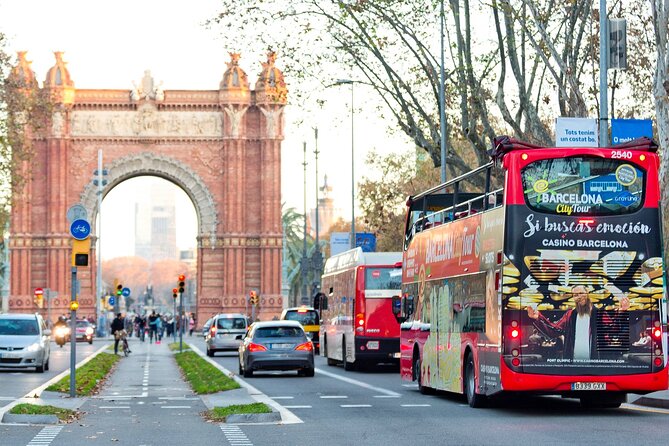
A major stop is Arc de Triomf. It’s a classic gateway and an easy reference point to understand how Barcelona connects grand city design to the harbor direction.
Passeig de Picasso and the daily street vibe
You’ll also see Passeig de Picasso & Passeig de Pujades. This area is useful because it’s not only about monuments. It’s about getting a sense of where locals walk, shop, and move between districts.
Museum and view stops that make the bus feel purposeful
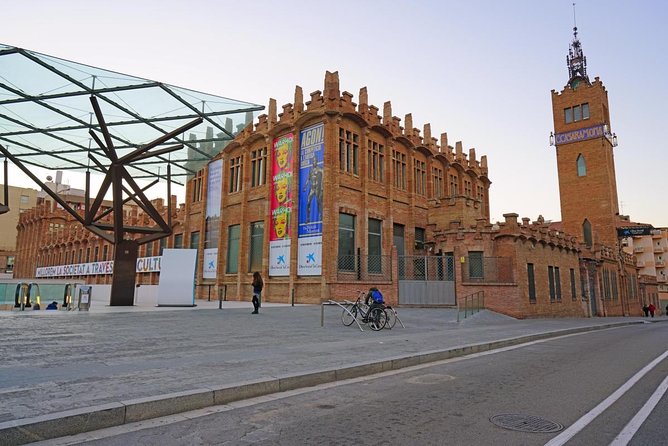
Stops include CaixaForum Barcelona and Avinguda de la Reina Maria Cristina. This is a good set of stops if you want a mix of “see it from the street” and “actually step out for an hour” options.
Poble Espanyol: cultural detour without booking ahead on the bus
If you want a themed diversion, the route includes Poble Espanyol. It’s a place where you can break up your day and avoid turning every hour into a line at a major landmark.
Estació de Sants and the big sports landmark
You’ll pass Estació de Sants and Spotify Camp Nou. Whether you care about stadiums or not, these stops are helpful for understanding Barcelona’s grid and how different neighborhoods connect.
Plaça de Francesc Macià, note on works
There’s a stop at Plaça de Francesc Macià, but it may be cancelled due to works, with an alternative location. So keep your eyes on updates when you arrive, because the bus route can adjust around city events and construction.
Back to Sagrada Familia and toward the sea
On the way back through the west loop, you’ll encounter Sagrada Família again, plus Barcelona Nord Bus Station, Carrer de la Marina, 37, and Port Olímpic, before returning toward Pla de Palau. This is valuable for two reasons: it creates a loop that’s easy to re-enter, and it gives you a second chance to catch areas you may have missed on the first pass.
Hop-on hop-off transfers: the part that can save you, or cost you time
The system is built so you can hop off as often as you like, then ride back on. But hop-on hop-off only works if you plan transfers with your feet in mind.
The most important practical tip: transfers between certain areas can involve real walking. For example, the map indicates a walk between the Sagrada Familia area stop and the Sant Pau stop that is about 10 minutes. That matters if you’re arriving at your next stop and expecting it to be directly “right there.”
Also, do not treat the bus like a metronome. City traffic can affect timing, and the schedule can shift due to events, demonstrations, sports, and official acts. Even if buses run frequently, the exact stop timing is not guaranteed.
Finally, there’s a system detail that surprises people: you redeem your voucher on board the bus. The staff give you your catamaran ticket, which is located nearby Columbus. If you are doing the boat upgrade, plan for that handoff and do not leave everything until the last minute.
The optional catamaran: coastal views, plus schedule reality
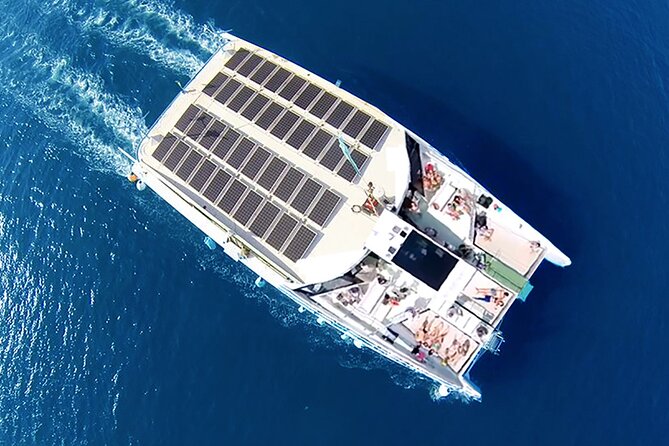
The boat upgrade is marketed as a simple add-on: a 1-hour tour along Barcelona coast, with boarding linked to stops near the harbor.
Here’s the good news. A boat ride from the harbor side gives you angles you cannot get from the streets. You’ll see the coast and port areas in a single sweep, and it can feel like a reset after hours of walking and waiting for buses.
Here’s the reality check. The catamaran has limited departures, and getting to the boat stop at the right time is critical. In bad weather, meeting the sailing schedule can be harder, and you can lose your spot if you arrive late. If rain, wind, or your own day plan throws you off, the bus flexibility does not always solve the boat timing problem.
The cruise also can be cancelled due to meteorological causes. If that happens, you are offered an alternative day if possible, and if not, a partial amount may be refunded. Since cancellation timing can affect your day, I treat the catamaran like your “anchor” activity.
Where you’ll board and which bus stops help you get there
For the boat experience, you’ll hop off at stops such as Arc de Triomf, Passeig de Colom, or World Trade Center. Then you head toward the harbor boarding area near Moll de les Drassanes. Before you start your day, check the sailing schedule.
One more planning tip: if you are trying to do strict timed-entry attractions, the boat upgrade may collide with your best “quiet windows.” Many people end up enjoying it, but you should decide based on your tolerance for schedule pressure.
Audio guide and top deck comfort: what the headset adds
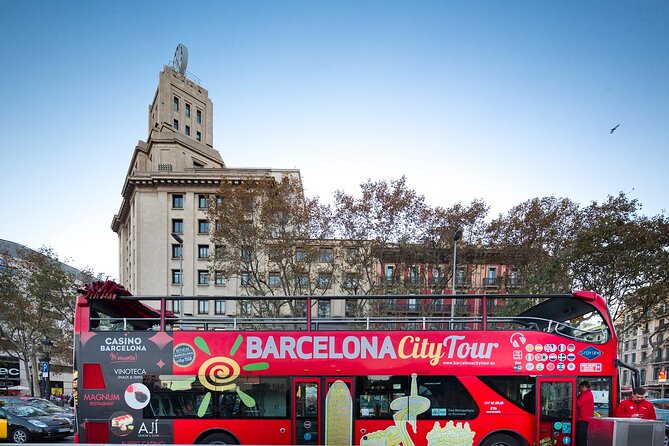
This tour’s audio is one of its real strengths. The commentary is available in several languages and helps you connect what you’re seeing to the bigger story behind it.
The big win is simplicity. You can listen while you move, then get off where the stop matches what you want to learn more about. It also means you do not need to stop at every corner museum just to understand the landmarks.
The headset system for different hearing needs
There is an audio system adapted for people with auditory disabilities, using a multilingual looping system. Seats with this feature are signaled, and passengers who need it get priority. If audio support matters to you, it’s worth identifying these seats quickly when you board.
Rain, wind, and the best seating choice
One common theme from real use: the top deck is popular, but it’s not only because of views. People also like the “watch the city roll by” feel. In rain, the covered upper deck still gives you a strong view, and that can be a comfort factor if your sightseeing day turns wet.
Small comfort notes
Expect some crowding during peak periods. A review also mentioned Wi-Fi can be spotty from the top deck, but works okay lower down. If Wi-Fi is important for you, do your uploads on the lower level.
Stop-by-stop strategy: how to build a satisfying day
A pass lets you ride more than one loop, so your goal is not to see every stop. Your goal is to pick the stops that match your energy and your interests.
If you only have 2 to 3 key attractions
Use the east route to build your “big four” Gaudí day:
- Park Güell (plan for walking time uphill)
- La Pedrera – Casa Milà
- Casa Batlló
- Sagrada Família (even if you just pass by on the bus, it sets your orientation)
Then use the bus to reposition for food and rest, rather than treating every stop like an obligation.
If you like neighborhoods, not just landmarks
Lean west. Get off at Arc de Triomf, wander toward the harbor area, and use stops like CaixaForum Barcelona and the Montjuïc-adjacent zone for a break between monuments.
If you want a morning plan and an afternoon reset
Do your walking-heavy sightseeing early, then keep one “bus-only” segment for later. People often get tired and start making mistakes when they push too hard too long. The hop-on hop-off flexibility is strongest when you save a few hours to decide on the fly.
Where to spend time versus where to just pass
Here’s a practical rule: if you care about tickets or interior visits, treat that stop as a time block. If it’s mostly for photos and street views, ride past first, then return if you want to linger.
That approach helps you avoid the classic hop-on hop-off trap: hopping off too often, then not having energy left when you reach the places you actually care about.
Price and value: what $39.65 buys you, and when it makes sense
At around $39.65 per person, the core value is the combination of:
- A 24-hour or 48-hour hop-on hop-off pass
- Two interconnected route options in one system
- Multilingual audio guidance
- Easy stop access around major sights
That price makes the most sense if you want a first-day orientation kit, or if your itinerary has enough variety that you do not want to commit to several separate attractions on day one.
The boat upgrade can be worth it if you can treat it as an anchor and you are comfortable timing your day around departure windows. If you suspect your schedule might be fragile, or you hate being rushed, stick with the bus and skip the catamaran. The bus alone already gives you lots of payoff, especially from the top deck.
And there is a small feel-good add-on: your ticket includes a contribution toward Mediterranean Sea clean-up and coral plantation. It will not replace ocean protection work, but it’s a nice bonus you do not get from most city buses.
Should you book this Barcelona City Tour with optional boat?
I’d book it if you want an easy, low-stress way to see major Barcelona sights without building a complicated transit plan. The interconnected routes and multilingual audio make this a strong “first 1 to 2 days” choice, and the top deck views work even on less-than-perfect weather.
I’d think twice about the catamaran upgrade if your day is already tight or if you dislike schedule-based activities. The bus is flexible, the boat is not. If you can handle departure times, you’ll likely enjoy the coast perspective a lot.
If you are someone who learns best with guided context and wants the freedom to stop and start, this is a solid buy. If you prefer totally independent exploring with taxis and your own rhythm, you might still use the bus as a sightseeing intro, then switch strategies.
FAQ
How long is the Barcelona City Tour hop-on hop-off with boat?
The tour duration is listed at about 2 hours 20 minutes, and the hop-on hop-off pass lets you keep exploring for the length of your chosen validity period (24 or 48 hours).
What is the price per person?
The price is $39.65 per person.
What ticket options are available, and how long do they last?
You can choose either a 24-hour or 48-hour pass. The 48-hour ticket must be used on consecutive days from the date of validation.
Can I start at any stop?
Yes. You can begin at conveniently located stops on either the east or west route.
Is there audio commentary, and is English included?
Yes. There is onboard audio commentary available in several languages, including English, depending on the audio system on the bus.
Is the boat cruise included automatically?
No. The boat experience is an optional upgrade. If you choose it, it includes a 1-hour tour along the Barcelona coast.
Where do I get the catamaran ticket if I upgraded?
You redeem your voucher on board the bus. The bus staff provide your catamaran ticket, which is located nearby Columbus.
What happens if the catamaran is cancelled due to weather?
If the catamaran is cancelled due to meteorological causes, an alternative day is offered if possible. If that is not possible, a partial amount of the reservation will be refunded.
Is free cancellation available?
Yes. You can cancel up to 24 hours in advance for a full refund.
More Boat Tours & Cruises in Barcelona



More Tours in Barcelona




More Tour Reviews in Barcelona

Not for you? Here's more nearby things to do in Barcelona we have reviewed










More Barcelona City Tours worth opening.
 ★ 4.4Park Güell Admission TicketFrom $2576,534 reviews
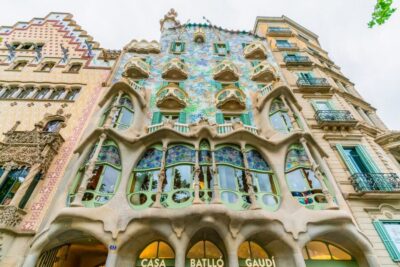 ★ 4.7Casa Batlló Entry with Self-Audioguide TourFrom $3425,359 reviews
 ★ 4.424 or 48-Hour Hop-On Hop-Off Bus TourFrom $3920,872 reviews
 ★ 4.7Park Guell Guided Tour with Skip The Line EntryFrom $3117,563 reviews
 ★ 5.0Barcelona in 1 Day: Sagrada Familia, Park Guell,Old Town & PickupFrom $12013,541 reviews
 ★ 4.3Barcelona Aquarium: Entry TicketFrom $3113,335 reviews
 ★ 4.8Sagrada Familia Skip-the-Line Entry Ticket & TourFrom $6712,789 reviews
 ★ 4.4FC Barcelona Museum “Barça Immersive Tour” TicketFrom $3510,944 reviews
Continue by place or experience